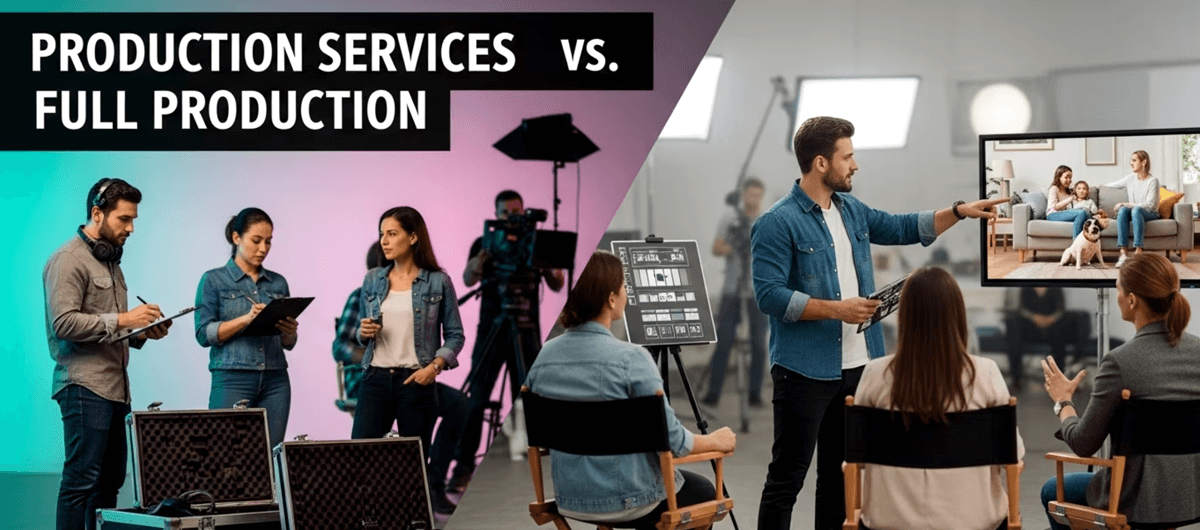
Production Services vs Full Production Company

Production Services vs Full Production Company: What’s the Difference and Which One Do You Actually Need?

In video production, clarity about who does what is everything. Yet one of the most common sources of confusion—especially for agencies, producers, or clients hiring out of market—is understanding the difference between production services and a full production company.

At first glance, they may seem like the same thing. Both involve cameras, crew, logistics, and execution. But in practice, they serve very different purposes and work under completely different creative structures.

Production services exist to support an existing vision. They’re the behind-the-scenes operators who make sure a shoot runs smoothly when another producer, director, or agency already has the creative direction in place. In contrast, a full production company isn’t just executing someone else’s idea—it’s shaping the creative from the ground up.

“A production service is when another producer already has the look and feel worked out. They have their own vision—and what they need is support: crew, gear, locations, and coordination.”

Understanding this distinction saves you time, money, and potential miscommunication. Hiring a team for the wrong purpose can lead to overlap, unclear responsibilities, and frustration on both sides.

In this article, we’ll break down the Production Services vs Full Production Company comparison—what each term means, how they operate, and how to choose the right approach for your project. Whether you’re a visiting producer looking for a local partner or a brand in need of full creative direction, knowing the difference ensures your shoot runs efficiently and achieves the results you want.

What Are Production Services?

In the Production Services vs Full Production Company discussion, the first step is understanding what production services actually mean.

A production service provider is not hired to lead the creative direction of a project — they’re brought in to execute someone else’s vision. Typically, these clients are other producers, agencies, or production companies visiting from another market. They already have a creative plan, a director of photography (DP), and a defined look and feel. What they need is on-the-ground support: reliable crew, gear, and logistics to bring that vision to life efficiently.

“They have their vision in place, but they know we have the resources of a full-service video production company.” We’re going to get them good rates, the right locations, the best people for their budget and their needs—and we’re not going to say a thing about how they should shoot it or light it.”

That quote captures the spirit of a true production services provider—supportive, professional, and execution-focused. Their job is to make things happen behind the scenes without altering the creative decisions that have already been made.

A production service often includes:

  • Crew Coordination: Hiring qualified camera operators, grips, lighting techs, and assistants.
  • Equipment Rental: Supplying or sourcing professional cameras, lighting, and audio gear.
  • Location Scouting & Permits: Finding spaces that match the client’s brief and handling necessary permissions.
  • Scheduling & Logistics: Managing timelines, call sheets, and transportation.
  • Budget Efficiency: Using local knowledge to secure competitive rates and avoid unnecessary expenses.

These teams are invaluable for out-of-town productions because they provide everything needed to execute a professional shoot—without interfering in the creative process.

In short, production services are about support, not direction. They handle the technical and logistical side so that the creative team can focus solely on making their vision happen, often relying on a dedicated production team.

What Is a Full Production Company?

In contrast to production services, a full production company doesn’t just provide crew or logistics—it provides creative leadership. When a client hires a full production company, they’re not arriving with a finished concept. They’re looking for a partner to develop, plan, and execute your vision with the help of a production studio. the project from start to finish.

A full-service production company combines both creative and operational expertise. It helps shape the idea, write the script, handle casting, plan logistics, direct the shoot, and oversee post-production. This means clients rely on the company’s artistic perspective as much as its technical capability.

“A production company provides all of that—plus creative input and expertise to make your shoot happen.”

That’s the defining difference. In the Production Services vs Full Production Company framework, a full production company is a strategic collaborator, not just an executor. They bring storytelling, vision, and problem-solving to every stage of production.

A typical full-service production company offers:

  • Creative Development: Concept creation, scripting, storyboarding, and visual planning.
  • Pre-Production: Casting, scouting, scheduling, and budgeting.
  • Production: Directing, cinematography, and on-set management.
  • Post-Production: Editing, color grading, sound design, and delivery.

This model suits clients who don’t have an internal creative team or who need end-to-end support—from idea to finished video.

Unlike production services, where the creative direction comes from elsewhere, a full production company helps define what the project will look and feel like. They don’t just provide the crew—they bring the vision, creative direction, and experience to make sure every frame communicates the right message.

In short, production services execute someone else’s plan, while a full production company creates the plan itself.

Key Differences Between Production Services and Full Production Companies

Although production services and full production companies may share overlapping tools and crew, the way they operate — and the value they provide — are fundamentally different.
The easiest way to think about it is: one supports the creative process by collaborating with a production team., the other leads.

Production services handle the execution — they provide the crew, equipment, and logistical coordination required to carry out a creative plan that already exists. A full production company, on the other hand, handles the creative strategy and production process from concept to delivery.

The table below breaks down the key distinctions:

AspectProduction ServicesFull Production Company
Creative RoleExecutes an external creative visionDevelops and directs the creative vision
Client TypeVisiting producers, agencies, or brands with their own directionBrands or clients seeking concept-to-completion video production
FocusCrew, logistics, locations, gearCreative, storytelling, logistics, and execution
Decision-MakingFollows the lead of the external creative teamLeads concept, visuals, and execution strategy
DeliverableRaw footage or on-set supportFully edited, finished video

“It’s the difference between simply providing crew and gear, and partnering on creative, logistics, and execution.”

That line from the video captures the divide perfectly. A production services provider is the reliable local partner who makes sure a visiting team’s plan goes off without a hitch. A full production company is the creative partner who develops that plan in the first place.

Both roles are essential, but they serve different needs. The key is knowing which one fits your situation — whether you’re bringing a vision that needs execution, or you need a partner to help craft that vision from scratch.

When to Hire a Production Services Provider

In the Production Services vs Full Production Company The distinction between a production company and a film studio is important when you already have your creative vision locked in — you just need a trusted team to make it happen locally.

A production services provider steps in when a producer, agency, or brand already knows what the project should look and feel like. The client has a Director of Photography (DP), a creative lead, or an external producer who’s directing the vision. What they need is a local partner who can provide the logistics, crew, and coordination to execute the shoot efficiently.

“They have their vision in place… but they know we have the resources. We’re going to get them the right locations, the best people for their needs, and we’re not going to say a thing about how they should shoot or light it.”

That quote defines the role perfectly — support without interference. Production service teams understand their job is to make the visiting producer’s shoot seamless and stress-free.

Typical scenarios for hiring production services include:

  • Out-of-town productions: When an agency or film crew travels to a new market and needs local support.
  • Agency collaborations: When a marketing agency already has creative direction but lacks on-the-ground resources.
  • Film and TV support: When larger productions need regional logistics, permitting, and crew.

The benefits of using professional production services include:

  • Local expertise: Knowledge of trusted crew, rental houses, and permitting requirements.
  • Cost efficiency: Access to competitive local rates and vendor relationships.
  • Time savings: Pre-built production infrastructure that minimizes setup time.
  • Logistical reliability: Coordinated scheduling, call sheets, and shoot management.

When to Hire a Full Production Company

If production services are for clients who already have a vision, a full production company is for those who need help developing one.

In the Production Services vs Full Production Company comparison, this is the defining difference: a full production company doesn’t wait for creative direction — it builds it. Clients who hire a full production company rely on them for creative strategy, storytelling, and hands-on execution from start to finish.

This type of partnership is ideal for:

  • Brands and businesses without in-house creative teams. They need help developing concepts, writing scripts, and planning shoots that align with their marketing goals, especially when working with a production team.
  • Organizations launching new campaigns. A full production company can shape the visual identity, messaging, and tone of the project.
  • Clients seeking long-term creative partners. Instead of one-off support, they want a team that understands their brand voice and can handle multiple productions over time.

A full-service production company brings together creative and operational expertise under one roof. They guide the entire process, including:

  1. Creative Development: Brainstorming, scripting, and storyboarding.
  2. Pre-Production: Casting, location scouting, scheduling, and budgeting.
  3. Production: Directing, filming, and managing the shoot.
  4. Post-Production: Editing, sound design, color grading, and delivery.

“When you’re coming into Miami, that’s what we do. We can provide production services through our film production team… but as a full production company, you also get our talent, our expertise, and our creative input to make your shoot happen.”

That line illustrates how both offerings can coexist under one roof — but they serve different needs. A production service delivers the manpower; a full production company delivers the vision.

If your project requires concept development, creative direction, and strategic storytelling — not just gear and crew — then a full production company is the right partner.

Why It’s Important to Know the Difference

In production, clarity saves money, time, and creative tension. Many clients blur the line between production services and a full production company, which often leads to duplicated work, budget overruns, or creative confusion, especially when you fail to distinguish between the roles of a production company and a film studio.

Understanding the Production Services vs Full Production Company distinction ensures everyone knows their role — and that you’re paying for the expertise you actually need.

If you hire a video production company, you can enhance your project with their expertise. production service provider but expect creative leadership, you’ll likely end up with logistical excellence but no one steering the storytelling. Conversely, if you hire a full production company when you already have your own director and DP, you might be paying twice for creative roles you’ve already covered.

“Production services are about providing crew and people… a full production company provides all that plus creative expertise.”

This difference defines how the collaboration unfolds:

  • Production Services → You bring the vision; they handle the logistics.
  • Full Production Company → You bring the goal; they handle the vision, logistics, and final execution.

The benefits of getting this right are tangible:

  • Clear responsibilities between teams.
  • Streamlined communication throughout pre-production and shooting.
  • More accurate budgets since you’re not paying for unnecessary overlap.
  • Better creative outcomes because everyone understands who leads what.

Knowing the difference between a production company and a film studio doesn’t just prevent mistakes — it helps you build partnerships that fit your workflow, your creative needs, and your bottom line.

Choosing the Right Option for Your Project

Now that you understand the difference between Production Services vs Full Production Company, the next step is choosing which one fits your project best. The right decision depends entirely on what stage your production is in and what kind of support you need.

If your creative vision is already defined—complete with a director, DP, and concept—you don’t need another layer of creative leadership. You need a production services provider who can make your plan work on the ground: hiring crew, managing gear, coordinating logistics, and securing locations.

If, on the other hand, you have a goal but no concrete concept, you need a full production company to help you shape that vision into a complete story. They’ll handle the creative direction, pre-production strategy, and final delivery.

Here’s a quick reference table to help you decide:

If You Already Have…Hire…Why It Works
A creative director, storyboard, or DPProduction ServicesThey provide crew, gear, and logistical execution for your existing plan.
A campaign idea but no creative directionFull Production CompanyThey help shape the concept, plan the shoot, and execute the vision.
Out-of-town production needing local supportProduction ServicesThey bring local expertise, resources, and vendor connections.
No internal video team or strategyFull Production CompanyThey provide end-to-end creative and production management.

Before you commit, ask yourself:

  • Do we need creative direction or just technical execution?
  • Who is leading the vision of this project?
  • Are we expecting finished edits or just The raw footage can be enhanced with visual effects to create a more compelling final product.?
  • Do we have local contacts for crew and logistics?

Your answers to these questions will make the choice clear.

In short:

  • If you’re bringing a vision, hire production services.
  • If you need a vision, hire a full production company.

Both play vital roles—but only one will be the right fit for where you are in your production process.

Understanding What You’re Hiring For

At its core, the Production Services vs Full Production Company distinction comes down to this:
Are you hiring for execution or for creative partnership?

Both models are valuable, but they serve completely different purposes. A production services provider is your go-to when you already have a creative team in place and just need reliable, local support to make things run smoothly. They handle the logistics, hire the crew, coordinate the vendors, and make sure your shoot stays on time and on budget.

A full production company, on the other hand, becomes your creative collaborator. They’re responsible not only for logistics but for shaping the vision—developing the concept, directing the shoot, and managing post-production. They bring artistic direction, storytelling experience, and a cohesive process from idea to final edit.

“It’s the difference between simply providing crew and gear, and partnering on creative, logistics, and execution.”

Understanding what you’re hiring for prevents costly overlap and sets clear expectations for everyone involved. It ensures your team works efficiently, your message stays consistent, and your budget is spent where it matters most.

If you’re an out-of-town producer with a finished concept, production services are the best fit. If you’re a brand, agency, or organization looking for concept-to-completion production, a full-service production company is the way to go.

In the end, success isn’t just about choosing a capable vendor—it’s about choosing the Finding the right type of partner, such as a full-service video production company, is key to your project’s success. for your needs. Knowing this distinction before you start makes every step of your project faster, clearer, and more effective.

Responsive Video Production Company

Responsive Video Production Company: Why Responsiveness Defines True Professionalism

In broadcast and commercial video production, one truth stands out above all others: deadlines don’t move. When your project is destined for air — whether on cable, network, or an OTT platform — delivery times are immovable, and mistakes have real costs. That’s where a Responsive Video Production Company proves its value.

Responsiveness in video production isn’t about replying to an email quickly. It’s about being ready when things change at the last minute — when a network’s delivery spec updates overnight, a client requests an edit before air, or equipment malfunctions hours before a shoot. In those moments, responsiveness means having both the availability and the resourcefulness to solve problems fast.

When the proverbial crisis hits, your client wants to know that you’ll answer — and start working on a solution.

That’s the mindset behind professional video production. The best companies don’t just meet deadlines; they protect their clients’ deadlines. They anticipate challenges, stay available after hours, and maintain constant communication so clients never feel left in the dark.

A responsive production company doesn’t just create content — it provides reliability under pressure. This article breaks down what responsiveness truly means in a production environment, why it’s essential for broadcast and corporate work, and how to identify a partner that treats your deadline like their own.

What “Responsiveness” Really Means in Video Production

In video production, the term responsive goes far beyond answering a phone call or email quickly. For a Responsive Video Production Company, responsiveness is a mindset — a commitment to staying available, adaptable, and proactive in solving problems the moment they arise.

Broadcast and commercial projects often operate under non-negotiable deadlines. Commercials must air on time. Network spots have delivery cutoffs. Corporate launches have fixed event dates. There’s no “we’ll get to it tomorrow” in this world — responsiveness is the difference between meeting a broadcast slot and missing it entirely.

You have to be responsive to all these things — the solutions you come up with are all in service of your client.

That quote reflects the foundation of professional video production. Responsiveness isn’t just about speed — it’s about dependability under pressure. It means picking up the phone on a weekend, responding to a late-night request, or finding a new solution when a problem surfaces unexpectedly.

At its core, being responsive is about client trust. When clients know they can reach you at any hour — and that you’ll have an answer — they stop worrying about what could go wrong. They know they have a partner who’s as invested in their success as they are.

A responsive video production company operates with a service mentality:

  • Availability: Always reachable, even outside standard business hours.
  • Adaptability: Ready to pivot when plans or deadlines shift suddenly.
  • Accountability: Taking ownership of every stage of the project, especially when things don’t go as planned.

In an industry where schedules are tight and stakes are high, responsiveness isn’t just a skill — it’s a core part of professionalism.

Why Being a Responsive Video Production Company Matters

In fast-paced environments like broadcast, streaming, or commercial production, responsiveness isn’t optional — it’s the foundation of client trust. A Responsive Video Production Company doesn’t just deliver high-quality work; it delivers peace of mind under pressure.

When a commercial spot is set to air on TV or a campaign launch is tied to a fixed event, every deadline becomes absolute. Clients expect their production partner to not only meet those deadlines, but to anticipate and resolve challenges before they cause disruption.

That single statement captures what separates a reliable production partner from the rest. It’s about availability and accountability. In the world of broadcast production, last-minute changes happen constantly — a sponsor swap, an updated logo, a new runtime requirement — and those updates can come after hours. A responsive production company treats those moments as part of the job, not as inconveniences.

Responsiveness also builds long-term confidence. Clients remember who answered the call when things went wrong. They remember who showed up, who took ownership, and who helped them make an impossible deadline. Over time, that reliability turns into loyalty — and loyalty turns into repeat business.

The value of responsiveness extends beyond emergencies. It shapes how projects run day-to-day:

  • Decisions get made faster.
  • Communication stays clear.
  • Production delays are minimized.

In short, responsiveness is what transforms a video vendor into a trusted production partner. In an industry where time is everything, a company’s ability to act quickly and communicate effectively is just as important as its ability to shoot beautifully.

Responsiveness and Problem Solving Go Hand in Hand

Responsiveness without problem-solving is just reaction time. In professional production, what truly defines a Responsive Video Production Company is its ability to not only respond quickly — but to respond effectively.

In broadcast production, problems are inevitable. Tight deadlines, changing client needs, or unexpected technical issues can appear without warning. What separates an experienced team from an inexperienced one is how fast they can pivot from “there’s a problem” to “here’s the solution.”

We’re problem solvers. We have to be responsive about solving those problems — it’s expected.

That expectation is the heartbeat of the industry. Clients don’t hire a video production partner just to film; they hire one to navigate challenges — scheduling conflicts, late script revisions, delivery format changes, or hardware failures — and still deliver on time.

A responsive, problem-solving production company:

  • Anticipates challenges before they happen, through experience and planning.
  • Communicates clearly when something changes, keeping clients informed.
  • Acts decisively to fix issues fast, without waiting for approvals that cause delays.
  • Provides alternatives, not excuses — offering workarounds that maintain quality and timing.

In deadline-driven industries like broadcast or OTT, the cost of delay is high. A missed airtime or undelivered spot can mean lost ad revenue, unhappy clients, and damaged reputations. That’s why the most valuable partners are those who combine quick thinking with calm execution.

A Responsive Video Production Company isn’t defined by how it works when everything goes smoothly — but by how it performs when things don’t. Responsiveness and problem-solving together are what make deadlines possible, trust sustainable, and partnerships long-term.

What Clients Expect from a Responsive Video Production Partner

Clients who work in broadcast or commercial production environments know one thing: unpredictable changes happen. Scripts shift, creative notes arrive late, technical specs get updated, and deadlines don’t move. What they expect from a Responsive Video Production Company is a partner who can absorb those challenges without slowing down the process.

Responsiveness, from the client’s perspective, means reliability under pressure. It’s not just about being reachable—it’s about being ready to take action. When clients pick up the phone, they’re not looking for an acknowledgment; they’re looking for a solution.

When my clients get that call from their client, they know they can call me — and I’ll already have a solution ready.

That’s the kind of confidence a responsive production partner provides. The client doesn’t have to wonder whether someone will answer, or whether the issue will be handled. They know it will.

What Clients Value Most in a Responsive Partner

  • Availability: They can reach you outside normal hours if something urgent arises.
  • Clear communication: Updates are fast, concise, and solution-oriented.
  • Proactive thinking: Anticipating potential issues before they become problems.
  • Follow-through: Commitments are met, even when the timeline gets tight.
  • Accountability: Taking ownership of challenges instead of shifting blame.

In broadcast and marketing production, clients rarely remember how easy a project was — they remember who helped them when things got difficult. That’s why responsiveness is more than a soft skill; it’s a differentiator that defines long-term relationships.

A Responsive Video Production Company doesn’t just deliver assets—it delivers trust. And in this business, trust is currency.

How Responsiveness Builds Long-Term Client Relationships

In video production, responsiveness isn’t just about meeting deadlines—it’s about building relationships that last. A Responsive Video Production Company turns quick reactions into lasting trust. Clients remember who answers when the pressure is on, and they reward that reliability with repeat business.

That kind of consistency builds confidence. Every time a production company solves a problem fast, it reinforces a simple truth: they can be counted on. Over time, that reputation for responsiveness becomes more valuable than any marketing effort.

Long-term relationships in production are rarely based solely on creativity or cost—they’re built on dependability. Clients stay loyal to teams who show up, communicate clearly, and deliver when circumstances get difficult.

Here’s how responsiveness directly strengthens client partnerships:

  • Reliability becomes your brand. Clients associate your name with stability and problem-solving.
  • You reduce client stress. They don’t need to manage every detail because they trust you’ll handle it.
  • You earn priority on future projects. Clients will bypass competitors for teams they know will deliver.

In broadcast and corporate production, where tight schedules and complex logistics are the norm, responsiveness isn’t a value-add—it’s a survival skill.
A Responsive Video Production Company doesn’t just deliver one successful project; it builds a cycle of trust that turns clients into long-term partners.

Signs of a Truly Responsive Video Production Company

Every production company claims to be responsive, but true responsiveness is proven through actions, not slogans. In a business built on deadlines, the real measure of reliability is how a team behaves when something goes wrong — not when everything goes right.

A Responsive Video Production Company operates with a service-first mentality. They’re proactive, available, and consistent, even when schedules tighten or communication breaks down on the client’s end.

If you’re evaluating potential partners, here are key signs of a genuinely responsive team:

1. They Communicate Quickly and Clearly

Responsive companies don’t let messages sit unanswered. They return calls, emails, and texts promptly — not just to respond, but to keep momentum moving. When something changes, they update all stakeholders immediately to avoid confusion or lost time.

2. They Anticipate Problems Before You Do

Experience teaches them what can go wrong — and they plan for it. Whether it’s building extra time into schedules or preparing backup equipment, they’re always one step ahead.

3. They’re Accessible When It Matters Most

Availability outside standard office hours is a hallmark of professionalism in broadcast and commercial work. A responsive production company understands that client emergencies don’t follow business hours.

4. They Offer Solutions, Not Excuses

When challenges arise, they focus on solving them — not explaining why they happened. Responsive teams come prepared with alternatives and next steps, turning potential roadblocks into progress.

5. They Have a Proven Track Record of Dependability

The best way to verify responsiveness is through reputation. Ask past clients how the team handled a crisis, met a tight deadline, or managed an unexpected change. Consistent feedback about reliability and communication is the clearest indicator of responsiveness.

In short, a Responsive Video Production Company doesn’t just meet expectations — it manages uncertainty. Their reliability isn’t situational; it’s structural, built into how they plan, communicate, and deliver.

True responsiveness isn’t advertised. It’s earned through years of showing up when it matters most.

How to Work Effectively with a Responsive Production Team

A Responsive Video Production Company thrives on collaboration. Responsiveness is most powerful when both sides — the production team and the client — communicate clearly, respect timelines, and share information early. The smoother that collaboration runs, the more efficiently problems can be solved and deadlines can be met.

To get the best results when working with a responsive production team, focus on three principles: clarity, preparation, and partnership.

1. Communicate Expectations Clearly

Responsiveness works best when expectations are set upfront. Provide as much information as possible about deliverables, timelines, approval chains, and any potential obstacles. When the production company knows what success looks like for you, they can align their workflow accordingly.

  • Share critical dates and milestones early.
  • Define how and when updates should be communicated.
  • Identify decision-makers to avoid approval delays.

2. Prepare for Contingencies Together

Even the most organized projects face unexpected issues — weather, client revisions, location conflicts, or equipment failures. A responsive production partner will already have backup plans in place, but collaboration helps ensure nothing falls through the cracks.

  • Discuss potential challenges before production begins.
  • Stay open to creative or logistical adjustments that maintain quality.
  • Use their experience to anticipate where flexibility will be needed.

3. Treat the Relationship as a Partnership

Responsiveness is a two-way effort. Clients who communicate openly and respect the production process make it easier for teams to deliver great results under pressure. Treating the company as a partner — not just a vendor — builds mutual accountability and trust.

When both sides operate with the same urgency and transparency, the results are consistent, on time, and on message. The project moves from being “managed” to being collaborated on, which is how responsive production companies deliver their best work.

The best production outcomes come from partnerships built on trust, communication, and a shared commitment to responsiveness.

Responsiveness Is the Real Competitive Advantage

In an industry defined by deadlines and constant change, responsiveness isn’t just a nice quality — it’s a competitive edge. The best creative ideas mean little if they’re not delivered on time, and the most advanced equipment can’t replace a partner who answers the phone when it matters.

A Responsive Video Production Company stands out because it does more than produce great-looking content; it protects the client’s timeline, reputation, and peace of mind. Responsiveness combines professionalism, accountability, and creative problem-solving — traits that separate seasoned producers from casual operators.

That expectation defines what it means to be a true production partner. Responsiveness transforms stress into trust, obstacles into opportunities, and one-time projects into ongoing relationships.

The next time you’re evaluating a production company, ask yourself:

  • Do they communicate fast and clearly?
  • Do they anticipate problems before they happen?
  • Do they take ownership when things change unexpectedly?

If the answer to all three is yes, you’ve found more than a vendor — you’ve found a Responsive Video Production Company. In broadcast and corporate production, that’s not just a service feature; it’s the standard of professionalism that clients depend on.

Video Production Company Specialization

Video Production Company Specialization: How to Know If a Team Is the Right Fit for Your Project

Just because someone owns a camera doesn’t mean they’re the right person to tell your brand story.
Owning equipment is one thing. Having the expertise to craft a professional, on-brand video is something entirely different.

That’s why one of the smartest questions you can ask before hiring anyone is simple: how do they approach their marketing strategy?

“Do they specialize in what I need?”

This is the heart of video production company specialization — understanding that not every team excels at every type of project. Some production companies are masters of brand storytelling. Others are built for quick-turn social content, detailed product demos, or high-pressure live events. None of these are inherently better than the others. The key is finding the one that fits your goals.

Hiring a company that doesn’t specialize in your type of video can lead to costly missteps — wasted time, mismatched tone, and results that don’t meet your expectations. The truth is, a great-looking reel doesn’t mean the company is right for your project. What matters is relevant experience — videos that prove they understand your industry, your audience, and the outcome you’re after.

In this article, we’ll break down why specialization matters, how to recognize it, and what questions to ask when evaluating a potential production partner. You’ll learn how to look beyond surface-level aesthetics and focus on what truly determines fit: experience, category alignment, and consistency of results.

Why Specialization Matters in Video Production

In the world of video production, specialization isn’t just a marketing term — it’s the difference between a good result and a great one. The most successful projects come from teams that know their strengths, have honed a clear niche, and can point to consistent results within that focus.

A company’s ability to produce excellent videos doesn’t mean it’s equipped to handle every kind of video. Video Production Company Specialization ensures that the team you hire has already faced — and solved — the specific challenges your project involves.

Think of it this way: producing a live event requires fast problem-solving and technical coordination; producing a healthcare testimonial requires sensitivity and trust-building; creating a brand commercial demands visual storytelling and emotional nuance. These are entirely different skill sets, even if the tools are the same.

“Just because someone owns a camera doesn’t mean they’re the right person to shoot your brand spot.”

That analogy from the transcript captures the point perfectly. The equipment might be identical, but the craft—how the team applies creative and technical knowledge to your type of video—is what separates a specialist from a generalist.

When you work with a company that truly specializes, you benefit from:

  • Faster onboarding – They understand your goals, audience, and industry context immediately.
  • Smarter creative planning – They know which formats, tones, and story structures actually perform for your type of content.
  • Fewer revisions – Because they’ve done it before, they anticipate the needs and challenges of your specific project.
  • Better results – The final video aligns with your message, market, and objectives.

The takeaway: specialization isn’t about exclusivity — it’s about alignment. The best production partner for you isn’t the one that claims to “do it all.” It’s the one that does your kind of work exceptionally well.

What Specialization Looks Like

So what exactly does Video Production Company Specialization look like in practice?
It’s more than a niche label — it’s a company’s proven ability to produce specific types of videos successfully and consistently.

A production company’s specialization often reflects the kinds of stories it tells, the audiences it understands, and the environments it’s comfortable filming in. While all production teams use cameras, lighting, and editing software, their real skill lies in how they apply those tools to solve specific creative challenges.

Here are some examples of specialization areas you might find:

Type of SpecializationWhat They Focus OnIdeal For
Brand StorytellingEmotional, narrative-driven content that builds identityCommercials, brand films, corporate culture videos
Product DemosClear visuals and step-by-step explanationsTech companies, e-commerce, product launches
Corporate or Training VideosProfessional, instructional, internal communicationHR, compliance, employee education
Testimonial or Case Study VideosReal people sharing real experiencesHealthcare, B2B services, nonprofits
Social Media ContentShort-form, platform-optimized videosConsumer brands, marketing agencies
Live Events & StreamingReal-time coverage, technical precisionConferences, trade shows, corporate events

Most strong production companies excel in one or two of these categories, not all of them. That’s why identifying their specialty is crucial before signing a contract.

“Some teams are amazing at brand storytelling. Others do killer product demos. Some focus on social content; others, live events.”

That line from the video sums up the core truth: different production teams bring different strengths to the table, particularly in motion graphics and video content. Your goal isn’t to find the team that claims to do everything—it’s to find the one that does your type of project best.

When assessing a potential partner, review their portfolio with focus. Don’t just look for polished visuals. Look for projects similar in tone, purpose, and audience to what you want to create. The best indicator of future success is relevant experience, not generalized ability.

How to Identify If a Production Company Is the Right Fit

Finding the right creative partner isn’t just about liking their work — it’s about verifying that their documentary style aligns with your vision. Video Production Company Specialization aligns with your specific needs. The best-looking reel in the world doesn’t help if the company’s experience doesn’t match your project type.

Before committing to any production team, take the time to ask questions, review relevant work, and look for evidence of focus. A company that specializes in your category will speak confidently about the challenges, goals, and nuances that come with it.

Ask the Right Questions

When interviewing potential partners, clarity is everything. Ask direct, honest questions that reveal where their experience truly lies:

  • “What kind of projects do you usually work on?”
  • “Which type of video do you do best?”
  • “Who are your typical clients?”
  • “Have you produced videos similar to what we’re planning?

Specialized production teams will answer confidently and show patterns in their work. Generalists often give vague responses or pivot to unrelated examples.

Look at Their Portfolio Through Your Lens

Don’t just assess how visually impressive their work is—look for relevance. A company that excels in luxury product ads may not be the best fit for a medical testimonial, and vice versa.

When reviewing their portfolio, pay attention to:

  • Tone and messaging: Does it match your brand voice?
  • Audience fit: Have they worked with similar industries or target markets?
  • Execution style: Are their videos narrative, instructional, or event-based?

A company’s true video production specialization shows up in consistency — the kind of projects they repeat, refine, and deliver successfully, especially in video content.

Ask for Recent Work in Your Category

Request to see recent examples that match your project’s style or industry. This gives you an accurate picture of their current capabilities.

For instance:

  • If you’re producing healthcare testimonials, ask how they handle real people on camera.
  • If you’re creating product demos, look for clarity, pacing, and visual detail.
  • If it’s social media content should be engaging and tailored to fit within the overall marketing strategy., review how well their work performs in short-form formats.

“We always suggest asking to see recent work in the same style or category as your project.”

Specialization is proven, not claimed. The right company should be able to show examples that mirror your vision.

Why “We Do Everything” Can Be a Red Flag

When a company claims to “do it all,” that’s usually a sign to pause and consider their expertise in corporate videos. In video production specialization, focus is a strength. A team that understands its niche — whether that’s brand storytelling, corporate training, or product videos — brings refined processes, proven strategies, and predictable results.

By contrast, a company that says it specializes in everything often spreads itself too thin. Each type of video has its own demands:

  • Corporate films rely on structure, messaging, and brand tone.
  • Product demos require precision and visual clarity.
  • Testimonials demand authenticity and human connection.
  • Live events hinge on speed and technical reliability.

Excelling in all of these areas at once is rare. And when a company insists it can, that’s often a red flag—not because they lack skill, but because they may lack depth in any single discipline.

“Most production companies aren’t great at everything—and the ones who tell you they are, sometimes that’s a red flag.”

That insight from the transcript highlights the value of realism in high-quality video content. True professionals know their strengths and communicate them clearly. They’ll tell you where they shine—and where they’re not the best fit.

A specialized company brings experience that translates directly into efficiency in the production process. They’ve solved the same problems you’re facing, refined their workflow, and learned what works. Generalists, on the other hand, may still be figuring it out as they go.

When interviewing potential partners, pay attention to how they describe their capabilities. The best production companies demonstrate a strong understanding of the production process. focused expertise, not broad promises.

What to Look for in a Relevant Portfolio

A company’s portfolio is your clearest window into its video production company specialization. It tells you not just what they can do—but what they do best. Instead of focusing only on how polished their videos look, pay attention to how relevant their experience is to your specific goals.

A beautiful reel doesn’t guarantee the right fit. The real question is: Have they produced work like yours before?

Evaluate for Relevance, Not Just Quality

When reviewing a company’s work:

  • Match format and purpose. Are their videos similar in style, tone, or goal to what you want? A social media campaign, a brand story, and a healthcare testimonial each demand different storytelling approaches.
  • Assess their audience awareness. Do their examples speak to audiences like yours—corporate, consumer, healthcare, or B2B?
  • Look for consistency. Are their projects cohesive, or do they vary drastically in quality? Specialists deliver steady results within a focused range of video types.

“If you’re doing healthcare testimonials, you probably want to see examples of how they’ve handled real people on camera.”

That line from the video sums it up perfectly: relevant experience matters more than production polish.

Ask for Recent, Comparable Work

Always request to see recent projects that align with your project’s category. A company’s latest work shows you their current standards, tools, and creative direction.

  • For corporate content, look for clarity and tone that matches your brand.
  • For testimonials or interviews, pay attention to how naturally subjects come across on camera.
  • For product videos, evaluate lighting, pacing, and visual storytelling.

These details reveal whether the production team understands your project’s challenges and audience expectations.

A strong video production company portfolio is about fit, not flash. Choose the team whose work aligns most closely with your message, your audience, and your goals. That’s how you find a true creative partner, not just a service provider.

Questions That Reveal True Specialization

The best way to understand a company’s expertise is to ask questions that go beyond surface-level claims.
When you’re evaluating video production company specialization, your goal is to uncover whether the team has real experience with projects like yours—or if they’re stretching to fit the opportunity.

Here are key questions that separate genuine specialists from generalists:

1. “What kind of projects do you usually produce?”

A company’s answer should be clear and specific. If they mention two or three consistent categories—like corporate storytelling, healthcare testimonials, or product videos—that’s a sign of true focus.
Vague or overly broad answers (“We do everything!”) often indicate a lack of specialization.

2. “Can I see examples similar to our project?”

Ask for recent work that matches your industry, style, or tone. This isn’t about catching them off guard; it’s about seeing evidence of their post-production capabilities. relevant experience.
If you’re creating a training video, for instance, watch how they handle structure and clarity. If it’s a testimonial, note how comfortable real people appear on camera.

3. “Who are your typical clients?”

This question reveals whether their audience expertise aligns with yours. A company that usually works with startups might approach storytelling differently than one that serves enterprise clients or healthcare organizations.

4. “Do you handle creative development or only execution?”

Some production companies only handle filming, while others specialize in full creative direction—concepts, scripting, and strategy. Knowing where they fit ensures you choose a team that complements your internal resources.

5. “What challenges have you solved for projects like ours?”

This question exposes their problem-solving ability. Specialists can describe specific obstacles—tight schedules, limited locations, real-people interviews—and how they’ve overcome them. That’s a sign of experience, not improvisation.

6. “What would you recommend for our industry or goals?”

True specialists think strategically. They won’t just say “yes” to your idea; they’ll suggest improvements based on what’s worked in similar projects. That’s the kind of insight you get from focused experience.

By asking these questions, you shift the conversation from sales pitch to proof of capability.
The right video production company will welcome these discussions and respond with clarity, examples, and confidence. The wrong one will rely on buzzwords or generic promises.

The best production partners aren’t the ones who say “yes” to everything—they’re the ones who know where they deliver their best work.

How Specialization Affects Results

The quality of your final video depends less on how expensive the equipment is and more on how aligned your production partner’s skills are with your project goals.
That’s the real value of video production company specialization—you’re not just hiring a team with cameras; you’re hiring a team that understands the strategy, tone, and execution your specific type of video requires.

When a production company specializes in your area—whether that’s brand storytelling, corporate messaging, product marketing, or testimonial content—they already know what works and what doesn’t. They’ve tested lighting setups, pacing, and interview approaches that resonate with your kind of audience. That experience translates directly into:

  • Faster onboarding. Specialists don’t need lengthy explanations about your industry or audience—they already get it.
  • More efficient production. They anticipate creative and logistical challenges before they happen.
  • Better storytelling. They understand how to frame your message to make it clear, human, and persuasive.
  • Fewer revisions. Because they’ve done it before, the first cut is usually much closer to what you want.

“Specialty matters, so don’t just look for nice-looking videos. Look for experience that lines up with what you’re trying to make.”

That’s the core of it. When you work with a company whose specialization matches your project, you’re not paying for trial and error—you’re paying for precision. The result is a smoother process, a stronger video, and a partnership built on trust, not guesswork.

A specialized video production company doesn’t need to convince you with promises; their portfolio, process, and results already prove it.

Experience Over Equipment

In an era where anyone can buy a high-quality camera, it’s easy to mistake gear for expertise. But video production agencies can greatly enhance the overall quality. Video Production Company Specialization isn’t about who owns the latest equipment—it’s about who knows how to use it to tell the right story.

“Just because someone owns a camera doesn’t mean they’re the right person to shoot your brand spot. I mean, I own a frying pan. It doesn’t make me a chef.”

That analogy cuts to the truth of modern production. Tools are accessible; mastery isn’t. The difference lies in experience—how a team applies creative judgment, technical skill, and storytelling instinct to your type of video.

A specialized production company doesn’t waste time experimenting with formats they don’t understand. They’ve already learned what works, developed efficient workflows, and built confidence handling the kinds of situations your project will face. Whether it’s directing non-actors in a testimonial or lighting a branded interview in a busy hospital, specialists know how to make the process smooth and the footage effective.

In contrast, teams without specific experience often need extra takes, more direction, and longer edit timelines—all of which add cost and risk to the project.

That’s why specialization matters. A seasoned crew that has produced dozens of videos in your category brings practical insight no amount of equipment can replace. In video production, experience is the real investment that pays off—not just in how the video looks, but in how efficiently it gets made and how well it performs.

Choose Specialization, Not Generalization

At its core, a company in Video Production Specialization isn’t about exclusion — it’s about precision. Every type of video demands a specific creative mindset, production style, and storytelling approach. The best results come from working with a team that already knows how to deliver your kind of project.

Choosing a production partner isn’t about finding the biggest team or the fanciest gear. It’s about alignment: finding professionals whose experience directly matches what you’re trying to create. Specialists understand the nuances of your category—your audience, tone, and production challenges—because they’ve solved them before.

“Specialty matters, so don’t just look for nice-looking videos. Look for experience that lines up with what you’re trying to make.”

That’s the bottom line. A company that’s done similar work will always move faster, communicate better, and produce results that feel intentional and on-brand.
Generalists may promise flexibility, but specialists deliver focus—and in production, focus saves time, money, and creative energy.

When evaluating potential partners, look for consistent patterns in their portfolio, ask specific questions about past projects, and notice how confidently they talk about your industry or format. Those are signs you’ve found a true match.

In video production, specialization equals efficiency, reliability, and quality. The right creative fit doesn’t just make your video better—it makes the entire process smoother from start to finish.

Video Production Budget

Video Production Budget: Why Being Honest About Your Budget Leads to Better Results

Saying you don’t have a budget is like walking into a car dealership and saying, “I want something nice.”

The most common—and costly—missteps in video production: starting a project without defining, or at least discussing, the video production budget. It’s not about being rigid with numbers or revealing financial secrets. It’s about building clarity and saving everyone’s time.

A well-defined budget for video production is not a constraint—it’s a creative guide. Whether your project involves $5,000 or $50,000, that number sets the boundaries that determine what’s possible: the size of your crew, the quality of equipment, how many shoot days you can afford, and what level of post-production polish you can expect.

“Let’s talk budget—not because it’s fun, but because it saves everyone time.”

In this article, we’ll break down how transparency about your video project budget shapes every stage of production. You’ll learn why sharing your numbers openly doesn’t limit your options—it expands them. You’ll also see why honest conversations about the video production process lead to better storytelling, stronger collaboration, and ultimately, better videos.

Why Talking About Your Video Production Budget Matters

Every successful video project starts with one thing—clarity. And nothing clarifies creative direction, logistics, and production planning more than an open discussion about your video production budget.

Many clients hesitate to share their budget because they fear it will limit their options or give a production company leverage to “max it out.” In reality, the opposite is true. Budget transparency leads to smarter decisions, stronger partnerships, and better creative outcomes.

When you’re upfront about your budget range—even a rough one—you give your production team the information they need to design a project that fits both your goals and your resources. Knowing whether you’re working with $5,000 or $50,000 isn’t about prestige or scale; it’s about shaping a realistic plan.

What a Video Production Budget Actually Represents

Your video production budget is more than a financial figure. It’s a blueprint for your project’s creative and technical potential. It determines:

  • How many shoot days you can afford. A one-day corporate shoot looks very different from a three-day brand film.
  • Who can appear on camera. Can you use staff or will you need professional talent?
  • Where you can film. Will your office space work, or do you need a rented studio?
  • How complex your post-production will be. The budget defines how much editing, motion graphics, or sound design is realistic.

The clearer this information is, the easier it becomes for your production partner to focus on what matters—delivering value within your range.

Why Hiding Your Budget Slows Everyone Down

Refusing to discuss your video production budget early in the process leads to one of the biggest inefficiencies in the industry: wasted time.

When production companies don’t have even a ballpark number to work with, they’re forced to guess. That guesswork leads to:

Without Budget ClarityWith Budget Transparency
Proposals that miss your expectationsProposals that match your creative and financial goals
Revisions to the concept after pricingAligned creative ideas from the start
Delayed timelines due to re-scopingFaster approvals and production start

The result? You end up spending more time refining estimates than developing ideas. In contrast, when a client is open about their budget range, the production company can immediately tailor creative solutions that fit.

Budget Isn’t About Spending More — It’s About Spending Smarter

A video production budget isn’t a ceiling to be reached; it’s a framework for decision-making. A trustworthy production partner doesn’t want to max out your number—they want to help you allocate it efficiently.

That might mean:

  • Recommending a one-day shoot instead of two to stay within limits.
  • Using your office or conference room as a set to save on studio costs.
  • Suggesting your staff appear in the video instead of hiring actors.

It’s a collaborative process, not a negotiation. Sharing your numbers early empowers both sides to make smart trade-offs that get you the best video possible for the resources you have.

“It’s not about maxing out your number; it’s about helping you make smart decisions.”

When you treat your budget for video production as a tool rather than a secret, you replace guesswork with strategy—and that’s how better results happen faster.

The Difference Between a $5,000 and $50,000 Video Project

There’s a world of difference between a $5,000 project and a $50,000 one — and understanding that difference is critical when planning your video production budget. The number doesn’t just represent how much you’re spending; it defines what’s achievable within the time, equipment, and creative resources available.

Too often, clients approach a production company with a creative vision but no context for the scale required to execute it. They might envision cinematic lighting, multiple locations, actors, and a motion-graphic-heavy edit, all while assuming it can be produced on a modest budget. That mismatch between vision and resources is the main reason projects derail or require scope adjustments later.

Why Budget Size Matters

A video production budget shapes every component of the creative process:

  • Crew size and expertise: A small shoot might involve one or two camera operators. Larger productions include directors, producers, lighting techs, and specialized crew members from video production companies.
  • Time allocation: A smaller budget usually means a one-day shoot. Higher budgets allow multi-day filming and retakes for quality assurance.
  • Equipment quality: Entry-level cameras and minimal lighting setups differ drastically from high-end cinema gear and full lighting grids.
  • Locations: Lower budgets may rely on company offices or available spaces. Larger budgets can accommodate studio rentals, on-location shoots, and set design.
  • Talent: Do you feature real employees or hire professional actors and voice talent?
  • Post-production polish: More budget means more time for editing, color grading, audio design, and visual effects.

Each of these choices contributes directly to how polished and professional your final video looks.

How the Budget Influences Creative Approach

Production teams use your video project budget as a creative framework. The goal isn’t to spend more—it’s to make the smartest creative choices within your limits. Here’s a simple breakdown of how production value typically scales:

Budget RangeProject TypeCreative ApproachTypical Output
$3,000 – $7,000Small business or internal communications videosSingle-day shoots, simple lighting, minimal crewShort brand pieces, testimonials, social clips
$10,000 – $25,000Mid-level corporate or marketing campaignsOne to two-day shoots, higher-end gear, light creative directionPromotional or training videos with professional polish
$30,000 – $50,000+Agency-level campaigns, brand films, or commercialsMulti-day production, full creative development, dedicated crewHigh-production-value videos designed for broadcast or major campaigns

This table isn’t about “more is better.” It’s about realistic alignment. When both sides understand what each budget level allows, the creative process stays focused, and expectations stay grounded.

Why This Clarity Matters

When you tell your production partner your video production budget range, you help them design solutions that make sense for your goals. For instance:

  • With $5,000, they might plan a one-day shoot in your office using existing staff.
  • With $50,000, they could coordinate multiple locations, actors, and advanced post-production work.

The budget doesn’t limit creativity—it guides it. Just as a painter chooses materials based on the size of the canvas, production teams design around what’s feasible.

“Knowing whether you’re working with $5,000 or $50,000 makes a big difference in how a production team approaches the project.”

That difference determines everything from concept complexity to how effectively your message is communicated. By discussing your budget openly, you set the boundaries that make efficient creativity possible.

How Budget Clarity Saves Time

In video production, time is money—and nothing wastes more of both than avoiding the budget conversation. When clients hesitate to discuss their video production budget, production teams are left guessing. That guesswork often leads to mismatched proposals, delayed timelines, and unnecessary rounds of revisions before anyone even picks up a camera.

Being open about your budget early on doesn’t limit your creative potential. It actually accelerates it. Clear numbers allow your production partner to propose realistic concepts, assemble the right team, and allocate resources efficiently from day one.

Why Guessing Costs Time and Money

When a client says, “We don’t have a budget yet, just give us ideas,” the production company has no context for scale or feasibility. That’s like asking a builder to design a house without knowing if you can afford a cottage or a mansion. Both are possible—but the planning process for each is completely different.

Without budget clarity, the production team might spend hours developing a concept that simply isn’t viable within your means. Then, they have to go back, scale it down, and start over. That cycle adds days—or even weeks—to pre-production.

By contrast, when clients share even a ballpark video production budget, everything moves faster. The creative brief becomes more targeted, the proposal becomes more accurate, and approvals happen sooner in the video production process.

The Time Efficiency of Budget Transparency

Consider this simple comparison:

Without Budget ClarityWith Budget Transparency
Multiple proposals created to “test” client limitsOne focused proposal aligned with real resources
Back-and-forth revisions on creative scopeStreamlined approval process
Unclear expectations about deliverablesRealistic scope, clear milestones, and defined outputs
Extended pre-production phaseFaster kickoff and smoother workflow

Open communication about your video project budget ensures everyone is working toward the same goal—and at the same pace.

Why Clarity Improves the Creative Process

Time saved on re-scoping can be spent where it matters: refining storytelling, improving production quality, and focusing on your message. A well-defined budget for video production eliminates the uncertainty that stalls decision-making and keeps the creative energy moving forward.

When both the client and production company understand the financial boundaries, they can immediately focus on solving creative challenges rather than logistical ones. For example:

  • Can the concept be shot in one day instead of two?
  • Would using an available office location reduce rental costs?
  • Can we simplify post-production to meet a specific timeline?

Each of these questions becomes easier to answer when the budget is clear. The production company can quickly propose practical options instead of speculating.

“Let’s talk budget—not because it’s fun, but because it saves everyone time.”

That line from the video isn’t just advice—it’s a principle in the production process. Clear budgets create faster approvals, smoother collaboration, and a project that stays on track from start to finish.

Common Misconceptions About Sharing Your Video Production Budget

For many clients, the idea of openly sharing their video production budget feels uncomfortable. There’s a long-standing belief that talking about money too early will weaken negotiating power or lead to overspending. In truth, the opposite happens.

Hesitation around budget transparency doesn’t protect you—it slows down the process, limits creative options, and often leads to frustration for both sides. Understanding and addressing these common misconceptions can transform how you approach your next project.

“If I Share My Budget, They’ll Just Max It Out.”

This is one of the most frequent myths in video production, but it reflects a misunderstanding of how reputable production companies operate.

Professional teams aren’t looking to exploit your number—they’re trying to design the best creative plan within it. Your video production budget provides the framework that defines what’s possible. It helps your production partner:

  • Allocate resources efficiently.
  • Suggest cost-saving alternatives.
  • Prevent unnecessary upgrades or reshoots.

A good production company doesn’t build proposals that hit your ceiling—they design plans that maximize value within your range.

For example, if your budget is $15,000, a transparent partner may suggest a single high-quality shoot day instead of two, or recommend filming in your office to save location fees. Those choices make your money go further.

“I Don’t Know What Things Cost, So I’ll Wait to Discuss It.”

Not knowing what a video should cost is completely normal. Production pricing can feel opaque because it involves many moving parts—crew, gear, editing, logistics, and post-production.

But waiting to discuss budget doesn’t help. It forces your production partner to guess, and that guess may not match your expectations. Instead, share what you think you can spend, and let them guide you with cost benchmarks and examples.

A good production company will walk you through what’s achievable at different investment levels and show where things can flex. For instance:

  • A $5,000 video project might include one shoot day and minimal post-production.
  • A $20,000 video project could include professional talent, multi-location filming, and a higher-end edit.

Transparency at this stage doesn’t require precision—just a starting point.

“If I Share a Number, I Lose Negotiating Power.”

This mindset treats production like a retail transaction, but video projects are custom builds, not off-the-shelf products.

Your budget for video production is not an admission of weakness; it’s a collaboration signal. It tells the production company:

  • How much scope they should design for.
  • Which creative directions are viable.
  • How to balance production value and efficiency.

In reality, being upfront makes you a better negotiator because it allows both sides to discuss trade-offs intelligently. You can say, “This is what we can invest—how can we make it work best?” That’s a conversation rooted in partnership, not pricing games.

“We’ll Figure It Out Later.”

Deferring the budget conversation until “after the concept” almost always backfires. Concepts are built around assumptions—about scope, time, and resources. Without budget clarity, those assumptions are guesses.

When the real number finally surfaces, the concept often has to be scaled back, which wastes both creative energy and client trust.

By contrast, setting your video production budget early enables your production partner to design creative ideas that are both inspiring and feasible. You avoid the frustration of falling in love with an idea that later proves unaffordable.

The Truth About Budget Transparency

MisconceptionReality
Sharing budget leads to overspendingTransparency leads to smarter resource use
Waiting to discuss cost saves leverageEarly discussion builds trust and efficiency
Not knowing prices means avoiding the topicProduction partners can guide you through realistic ranges
Budgets should be kept secretBudgets are collaboration tools

Being open about your video production budget doesn’t give away control—it gives you clarity. It turns guesswork into dialogue and transforms the client-producer relationship into a partnership focused on solutions rather than surprises.

“The main thing is don’t treat a budget like a secret. Treat it like a tool.”

That’s not just a suggestion; it’s one of the most practical production strategies you can follow.

How to Determine Your Video Production Budget

You don’t need to know your video production budget down to the penny—but you should have a realistic range in mind before calling a production company. Budget planning doesn’t have to be complicated; it’s about understanding what resources you already have, what you’ll need to outsource, and how those factors impact the overall cost of your project.

The goal isn’t to overestimate or underprice—it’s to provide your production partner with enough information to design a creative plan that fits your vision and financial comfort zone.

1. Identify What You Already Have Access To

Start by looking at your existing resources. Many cost decisions depend on what’s already available versus what needs to be rented or created from scratch.

Ask yourself:

  • Do we have a location to shoot in? Your office, warehouse, or conference room might work as a practical set.
  • Do we have on-screen talent available? Can employees represent the company, or do we need professional actors or models?
  • Do we already own or have access to gear? Some businesses already have cameras or lighting equipment that can reduce the cost of video production.

For example, if your team can repurpose an office as a filming space, you might save $1,000–$2,000 in studio rental fees. Similarly, using real staff instead of actors can reduce casting and talent costs substantially.

Knowing what you have access to helps your production partner allocate your budget for video production more efficiently and suggest creative solutions to maximize it.

2. Determine What You’ll Need to Hire or Rent

After identifying what’s available, list what you’ll need to bring in externally. These are the core elements that drive most Understanding video production costs is essential for creating an effective video marketing strategy.:

Production ComponentDescriptionTypical Cost Range*
CrewDirector, camera operators, gaffer, sound tech$1,500 – $5,000 per day depending on scale
TalentActors, models, or voice-over professionals$500 – $2,000 per day per person
LocationsStudio or on-site venue rentals$1,000 – $3,000 per day
EquipmentCameras, lighting, audio gear, accessories$800 – $2,500 per day
Post-ProductionEditing, color grading, sound mixing, graphics$1,000 – $5,000 depending on complexity

*These numbers are illustrative averages and vary widely by region and production scope.

Understanding these cost categories helps you have an informed conversation with your production partner about where you can adjust or prioritize spending.

3. Define Your Must-Haves vs. Nice-to-Haves

Every project benefits from separating essential elements from optional enhancements.

  • Must-haves are non-negotiable: key interviews, core brand visuals, or mandatory messages.
  • Nice-to-haves are enhancements that elevate production quality but aren’t critical to achieving your goal—like motion graphics, drone shots, or extra filming days.

By distinguishing these early, you empower your production company to make trade-offs intelligently. For example, removing a non-essential animation sequence might free up budget for better lighting or additional camera coverage.

4. Ask for a Ballpark Estimate

If you genuinely have no idea what your video production budget should be, ask your production partner for a ballpark range. A professional company will walk you through what’s achievable at different spending levels, explaining how certain decisions affect cost.

You might hear something like:

  • “With $10,000, we can do a one-day shoot with two cameras and simple editing.”
  • “With $25,000, we can include multiple locations, actors, and custom graphics.”

This kind of transparency helps you see what’s realistic before finalizing your scope. The goal isn’t precision—it’s establishing budget direction early so creative discussions stay grounded in reality.

5. Remember: It’s Okay Not to Know Exact Numbers

Many businesses don’t have a frame of reference for production costs—and that’s completely fine. What matters is openness regarding the video budget. Share what you do know:

  • Your target outcome (a commercial, testimonial, training video, etc.).

  • Your desired timeline.

  • Your available resources or constraints.

From there, a good production partner will help you refine the numbers, not judge them. Budget planning is a collaborative process that ensures both creative ambition and financial practicality coexist from the start.

“If you genuinely don’t know what things cost, that’s okay. A good production partner should walk you through a ballpark cost for your video marketing project and show you where things can flex.

That’s how smart budgeting works—not as a guessing game, but as an informed conversation.

What Affects the Cost of a Video Project

Your video production budget is shaped by several key factors that determine how big, complex, and polished your final video can be. Understanding these variables helps you make smarter choices and keep your project aligned with both goals and resources.

1. Number of Shoot Days and Crew Size

Every extra day of filming adds cost for crew, gear, and logistics.

  • One-day shoots work for interviews or testimonials.
  • Multi-day shoots allow for more visuals but require higher budgets.

Crew size also matters: a small team can handle straightforward shoots, while larger productions may include producers, lighting techs, and sound engineers. More expertise adds cost but ensures a smoother, higher-quality result.

2. Equipment, Locations, and Talent

The gear, setting, and people in front of the camera define production value.

  • Using your office or staff can cut costs.
  • Renting a studio or hiring actors raises production expenses but often improves polish.
  • Professional lighting, sound, and camera equipment improve quality but require rental fees.

Being open about your budget for video production lets your production company recommend the right mix of tools, talent, and locations for your goals.

3. Post-Production and Editing

Editing, color grading, graphics, and sound design often represent 20–40% of total production cost. The more complex the final product—motion graphics, multiple deliverables, or revisions—the higher the post-production investment.

4. Project Scope and Management

Pre-production planning (scripts, scheduling, scouting) might not appear on screen, but it drives efficiency and avoids costly delays. Skipping this stage often leads to overspending later.

Key Takeaway

Every choice—from how long you film to where you shoot—affects your video project budget. The right production partner helps you balance quality and cost, guiding you on where to invest and where to save.

“All those things depend on budget, and if you genuinely don’t know what things cost, that’s okay. A good production partner should walk you through a ballpark cost and show you where things can flex.”

When You Don’t Know What Things Cost — and Why That’s Okay

Many clients start a project without knowing what a video production budget should look like. That’s completely normal. Video production involves many variables—crew size, gear, locations, and post-production—so it’s unrealistic to expect exact numbers upfront.

The key isn’t knowing the price of everything—it’s being open about what you can invest. A good production company doesn’t expect you to arrive with a perfect figure; they expect a conversation. When you share even a rough range, they can guide you through realistic options and show how certain decisions affect cost.

For example, a one-day corporate shoot with minimal editing might fit into a $5,000–$8,000 range, while a multi-location commercial could require $25,000 or more. The gap isn’t about overspending—it’s about scope.

“If you genuinely don’t know what things cost, that’s okay. A good production partner should walk you through a ballpark cost and show you where things can flex.”

That’s what a trustworthy partner does: turns uncertainty into clarity, helping you understand what’s possible within your video project budget without pressure or guesswork.

Treat Budget as a Tool, Not a Secret

Your video production budget isn’t something to hide—it’s a tool that helps your production partner make smart, creative decisions on your behalf. The more openly you share your budget, the faster your team can determine what’s realistic and where resources will have the most impact.

When clients treat budget information as confidential, production companies are forced to guess. That guesswork often leads to proposals that miss the mark, wasted pre-production time, and frustration on both sides. But when you’re transparent about costs, you invite collaboration in your video production project. You allow your production team to design solutions that align perfectly with your goals and financial comfort zone.

Budget transparency also helps you identify trade-offs early. For instance:

  • Using your office as a location might free up funds for better lighting or post-production in your video production project.
  • A one-day shoot instead of two could fund custom motion graphics or professional narration.

It’s not about spending more—it’s about spending smarter.

“The main thing is don’t treat a budget like a secret. Treat it like a tool.”

That’s the difference between guesswork and partnership. When you view your video project budget as a shared resource, it becomes the foundation of a productive, creative, and efficient collaboration.

Excellent — here’s the final main section, concise, practical, and fully consistent with the transcript’s message. It’s naturally optimized for Video Production Budget and variations such as budget transparency in video production, video project budgeting benefits, and sharing your production budget.

The Outcome — Better Results Through Budget Transparency

When you’re open about your video production budget, you set the foundation for success. Clear communication about cost isn’t about numbers—it’s about alignment. It ensures that your expectations, your production team’s plan, and your available resources all move in the same direction.

Clients who discuss their video budget early consistently see better outcomes because the production company can tailor the video production process to their needs.

  • Propose realistic creative concepts from the start.
  • Allocate time and crew efficiently.
  • Deliver high-quality results without costly revisions.

Transparency eliminates the guesswork that slows projects down. Instead of spending weeks re-scoping or scaling back ideas, both sides work within a clear framework that leads to smarter creative choices and smoother production.

“The more open you are with your budget, the better results you’re going to get.”

That statement summarizes the heart of every successful project. Treating your video production project with care ensures that you stay within budget. video production budget as a planning tool builds trust, speeds up collaboration, and ultimately produces stronger, more effective videos.

Video production Collaboration vs Creative Control

Video production Collaboration vs Creative Control – How to Avoid Endless Feedback Loops Before They Start

The fastest way to slow down a video project?
Letting everyone assume someone else is in charge of the creative.

It’s a silent killer of production timelines — and it happens more often than missed deadlines or busted budgets. When creative control and collaboration aren’t clearly defined from the start, projects spiral into confusion. Feedback loops multiply, emails pile up, and no one’s sure who has the final say on what the video should actually look like.

Before any camera rolls or storyboard is drawn, there’s a critical step most teams skip: deciding what kind of creative relationship they actually want with their production company. That one decision — who drives the creative direction and how collaboration happens — can determine whether your project stays on schedule or drowns in revisions.

In this article, we’ll break down:

  • What creative control vs. collaboration really means in video production.
  • The three types of creative relationships you can choose from before hiring a team.
  • Why vagueness kills momentum (and budgets).
  • How to align internally so feedback becomes a tool, not a trap.

“One of the biggest things that can derail a video project isn’t budget or gear — it’s when creative roles aren’t clearly defined.”

That insight, straight from a producer who’s seen dozens of projects stall because of unclear expectations, captures the problem perfectly. Every successful project begins with clarity — who’s steering the creative, and how collaborative the journey will be.

Suggested Titles (With Hook & Anti-Hook Variations)

  1. Video Creative Control vs. Collaboration: The Real Reason Projects Get Stuck in Endless Feedback
  2. Who’s Really in Charge? How Creative Control vs. Collaboration Shapes Every Video Project
  3. Stop the Feedback Loops: Define Creative Roles Before Your Next Video Shoot
  4. Why Budget Isn’t the Problem — Misaligned Creative Control Is

Why Video Creative Control vs. Collaboration Matters in Video Production

If you’ve ever worked on a video project that felt like it would never end, chances are the problem wasn’t the lighting setup or the camera gear — it was creative confusion.

When it’s unclear who owns the creative direction, projects slow to a crawl. Every new round of feedback reopens old decisions. Every stakeholder adds “just one more” note. What started as a clear concept becomes a loop of revisions that nobody signed up for.

And it all stems from one question no one asked early enough:

“Who’s actually driving the creative?”

The Real Cost of Creative Confusion

When creative control and collaboration aren’t aligned, projects pay the price in three ways:

Hidden CostWhat It Looks LikeImpact on the Project
Lost TimeEndless feedback cycles, unclear revisionsDeadlines slip, morale drops
Wasted BudgetPaying for additional edit rounds or reshootsCosts spiral beyond scope
Brand Drift can be mitigated when video production teams work together effectively.Inconsistent messaging or visualsThe final video misses the mark

This problem doesn’t just affect first-time clients. Even experienced marketing teams fall into the trap of assuming that “collaboration” means everyone gives feedback, while the production company somehow reads minds and delivers a unified vision of high-quality content.

But here’s the truth: collaboration isn’t the same as creative direction. Collaboration is a method. Creative control is a responsibility. When those two are blurred, accountability disappears — and so does efficiency.

Why Defining Roles Early Fixes Everything

Projects that begin with a clear agreement on creative control and collaboration move faster and cost less. Here’s why:

  • Fewer revisions: When the creative owner is clear, decisions get made once, not five times.
  • Better communication: Everyone knows who to go to for answers, and who signs off.
  • Aligned vision: The production company understands exactly how much input they should have — whether they’re executing, co-creating, or leading.

According to internal agency surveys, teams that define creative roles before kickoff cut production time by up to 25% and reduce revision costs by 30% or more. It’s not about working harder — it’s about working aligned.

The Three Creative Relationship Models in Video Production

Before you hire a video production company, one of the smartest things you can do is decide what kind of creative relationship you actually want.

Not every project needs a full-service creative partner. Sometimes you just need an extra set of hands. Other times, you need strategic guidance from day one. The key is knowing this before the first kickoff call — because how you define your creative relationship determines how the project runs, how much collaboration is expected, and how feedback flows.

Here are the three main creative control vs. collaboration models most production partnerships fall into:

1. Full Creative Control — You Lead, They Execute

This model works when your internal team already has a locked concept, script, or storyboard, and you simply need a crew to bring it to life.

  • Who drives the creative? You.
  • Who executes the creative? The production company.

Think of this as hiring a skilled technician to realize your already-defined vision. You maintain total control over look, tone, and messaging.

When it works best:

  • You have a creative department, marketing agency, or in-house content team member dedicated to high-quality video production.
  • Your concept is approved and ready to shoot.
  • You need flawless execution — not brainstorming sessions

Example:
A national brand has an agency-developed ad campaign. They hire a production company to shoot the commercials according to detailed creative boards and scripts. The production company focuses purely on logistics, talent, and production quality.

Risks:

  • Limited flexibility if something in the concept doesn’t translate visually.
  • Frustration if the production team spots potential improvements but isn’t empowered to suggest them.

2. Shared Collaboration — You Co-Create the Creative Together

This is the middle ground — and often the most common approach for mid-size brands and marketing teams.

You bring ideas, goals, and brand insights. The production company brings storytelling expertise, visual direction, and technical know-how. Together, you shape the message, tone, and structure of the project.

When it works best:

  • You have a strong understanding of your goals but want guidance translating them into video.
  • You value input on structure, visuals, and messaging.
  • You’re open to creative dialogue but want to stay involved.

Who drives the creative? Shared leadership — your team sets direction, the production partner refines and executes.

“Do you want someone who helps shape the concept and messaging with you?”

That’s this model — a balanced partnership between control and collaboration.

Risks:

  • If decision-making authority isn’t clearly defined, co-creation can slip into confusion.
  • Too many voices in the mix can slow approvals and blur accountability.

3. Full Creative Partnership — They Lead, You Approve

In this model, you hire a production company to take the lead from day one — concept, scripting, creative direction, and execution. You approve major milestones, but the creative responsibility lies fully with them.

When it works best:

  • You’re short on time or internal creative resources.
  • You want a partner to develop and manage the creative vision end-to-end.
  • You trust their expertise and want a hands-off experience.

Who drives the creative? The production company.
Your role: Provide brand guidelines, feedback, and approvals.

Example:
A healthcare organization wants a patient testimonial campaign but doesn’t have time to develop the creative concept. They hire a production company to handle everything — story development, interviews, and editing — while internal stakeholders approve final cuts.

Risks:

  • If trust or communication isn’t strong, results may not align perfectly with brand tone.
  • It requires letting go of some control — which not all teams are comfortable with.

Summary Table: Creative Control vs. Collaboration Models

ModelWho Leads CreativeBest ForPotential Risk
Full Creative ControlClientEstablished concepts, internal creative teamsLess flexibility during production
Shared CollaborationBothTeams seeking creative input & technical supportRisk of blurred decision-making
Full Creative PartnershipProduction CompanyBusy teams, or those without internal creative resourcesRequires trust and open communication

Each of these models can lead to great results — as long as you choose intentionally and communicate clearly before production begins.

The Real Problem — Being Vague About Creative Roles

Most video projects don’t fall apart because of bad ideas or small budgets. They unravel because no one clearly defined who’s steering the creative ship.

When creative ownership is vague, everyone feels responsible — which really means no one is. That’s when you start seeing the symptoms every producer dreads:

  • Multiple rounds of revisions where earlier decisions are rehashed.
  • Contradictory feedback from different stakeholders.
  • Confusion over who has final approval.
  • Delays that turn a two-week edit into a six-week odyssey.

“What usually doesn’t work is being vague or figuring it out as you go. That’s when you start burning time and budget in endless feedback loops.”

The Cost of Vague Creative Control

To understand why clarity matters, look at how ambiguity quietly multiplies effort and expense:

PhaseWithout Clear RolesWith Defined Creative Roles
Pre-ProductionTeam debates direction after kickoffEveryone knows the creative goal before day one
ProductionConflicting on-set feedbackOne decision-maker approves shots on set
Post-ProductionEndless edit versions and conflicting notesStreamlined approvals from a single creative lead
Final DeliveryLast-minute creative “pivots”Aligned vision and timely completion

A project that should take 4 weeks can easily double in duration when roles are unclear — and every extra week means additional cost for crew, editors, or opportunity loss.

Why Vagueness Creeps In

Vagueness isn’t intentional. It usually happens because:

  • Internal teams assume “collaboration” means equal input.
  • No one discusses creative ownership during early planning calls.
  • Decision-making authority shifts mid-project as new stakeholders join.

Each of these small oversights adds friction until creative progress grinds to a halt.

The Endless Feedback Loop Trap

Here’s how the loop usually forms:

  1. The client provides a general concept but doesn’t define how much control they want to retain.
  2. The production company makes creative choices to fill the gap.
  3. After seeing the first cut, new internal voices weigh in.
  4. Revisions pile up as everyone reinterprets the original goal.

This is the “feedback loop” problem — and once you’re in it, it’s hard to escape, especially in video production teams.

The Fix: Define Roles, Then Document Them

The simplest and most effective solution is to decide early:

  • Who drives the creative?
  • Who contributes feedback?
  • Who gives the final sign-off?

Then, document it in writing — even a short note in the project agreement helps.

It’s not bureaucracy; it’s clarity. And clarity is what separates smooth, professional productions from chaotic ones.

How to Define Video Creative Control and Collaboration Before Hiring a Production Team

Before you sign a contract, pick a director, or share a single storyboard, there’s one conversation that determines how smoothly your entire production will run: what kind of creative relationship are we building?

This step isn’t about overplanning; it’s about alignment. Whether you want total control or a fully collaborative approach, defining that balance early prevents wasted hours and repeated edits later.

1. Align Internally Before You Hire

Before reaching out to a production company, get your own team on the same page. You don’t need a perfect creative brief yet — just shared understanding.

Ask these questions internally:

  • Who’s leading the creative direction?
  • What kind of input do we want from our production partner — execution, guidance, or full creative ownership?
  • Who’s the final decision-maker on the project?

This internal clarity ensures you speak with one voice when you meet potential vendors. It also signals professionalism — production companies can tell instantly when a client has done their homework.

2. Communicate Creative Expectations Early

Once you start talking to a production team, be explicit about what you need from them. Ambiguity breeds confusion.

Here are a few clear ways to frame your creative expectations in the first conversation:

If You Want…Say This to Your Production Partner:
Full Creative Control“We have a defined concept and want your team to execute it exactly as planned.”
Shared Collaboration“We have ideas and goals, but we’d like your input to refine the concept and messaging.”
Full Creative Partnership“We’re looking for a creative partner from day one who can help us shape the concept, script, and delivery.”

Each of these relationships can work beautifully — but they only work when both sides know which one they’re in.

Being upfront saves everyone time. It tells the production company how much strategic input to prepare for and helps them assign the right creative leads to your project.

3. Document It in the Scope of Work

Don’t rely on verbal agreements when defining creative control and collaboration. Even a brief section in your scope of work or proposal makes a big difference.

Include:

  • Creative ownership: Who has the final say on direction and approvals.
  • Collaboration expectations: Whether brainstorming sessions, storyboarding, or messaging workshops are part of the scope.
  • Feedback structure: How many rounds of revisions are included — and who consolidates internal feedback before sending it to the production team.

By codifying expectations early, you replace assumptions with clarity — and eliminate the single biggest source of tension between clients and production teams.

Pro Insight

Projects run smoothly when everyone knows exactly who’s steering the creative and what kind of support they expect. This clarity turns collaboration from chaos into efficiency.

Aligning Expectations Prevents Endless Feedback Loops in Video Production Collaboration

In every successful video production collaboration, one thing stands out: clarity.
Not just in the visuals — but in roles, decision-making, and ownership.

When expectations around creative control vs. collaboration are defined before production begins, projects move faster, communication flows smoother, and everyone involved knows exactly when and how to give input.

But when those expectations are vague, the project stalls. Revisions pile up. Emails multiply. Time, energy, and money are burned on confusion that could have been avoided with a single conversation.

How Misaligned Collaboration Creates Feedback Chaos

Here’s what happens in most teams that skip this step:

  1. The client expects to lead the creative.
  2. The production company assumes they’re co-creating it.
  3. Each round of edits feels like a reset instead of progress.
  4. Everyone starts to lose confidence in the project’s direction.

That’s the classic endless feedback loop — where “collaboration” becomes code for redoing work that wasn’t aligned in the first place.

The Power of Clear Video Collaboration Roles

Defining creative ownership doesn’t make your process rigid; it makes it productive.
When both client and production partner understand the video collaboration process, feedback becomes targeted, efficient, and actionable.

ApproachWhat It Looks Like in PracticeImpact on Workflow
Undefined CollaborationEvery stakeholder gives separate feedbackConfusion and conflicting directions
Defined CollaborationOne creative lead consolidates all internal notesFaster edits, fewer revisions, smoother delivery

For example, in one campaign review conducted by a Miami-based agency, teams that identified a single creative decision-maker before production began reduced revision rounds by 38%. That’s not just time saved — it’s measurable ROI in production efficiency.

How Alignment Speeds Up the Collaborative Video Workflow

A healthy video production collaboration has three traits:

  1. Clear creative hierarchy: Everyone knows who gives input, who reviews, and who approves.
  2. Structured feedback cycles: Feedback windows are defined before the edit even begins.
  3. Mutual respect for roles: The production company respects the client’s brand knowledge, and the client respects the production team’s creative expertise.

These principles turn collaboration into a rhythm — not a tug of war. Instead of fighting over creative control, both sides channel their strengths toward the shared goal: a polished, on-brand, high-performing video.

“A little clarity up front goes a long way, regardless of who you hire.”

That line from the original video says it all. When roles are clear, collaboration in video production becomes not just easier — it becomes the secret weapon for faster, better creative results.

Who Should Drive the Creative in a Video Production Collaboration?

In any video production collaboration, one of the most important early questions is: Who’s driving the creative vision?
Is it your internal marketing or communications team, or the production company you’re hiring?

This decision isn’t about ego—it’s about efficiency. Creative direction determines how ideas flow, who has the final word, and how much flexibility exists during production. When it’s clear who’s leading, every aspect of the video collaboration process becomes smoother and more predictable.

When Your Internal Team Should Lead the Creative

Your team should take the lead when you already have a defined concept, brand message, or campaign narrative and simply need a professional crew to execute. In this case, your production partner functions as an extension of your team—handling the technical and logistical side while you retain creative control.

This approach works best when:

  • You have internal creative talent, such as a marketing director or content strategist.
  • The brand voice, visual style, and campaign goals are already established.
  • You need execution support rather than conceptual development.

Benefits:

  • Complete control over creative direction.
  • Consistency with internal brand messaging.
  • Faster approvals because decisions are made internally.

Considerations:
This model only works if the production brief is detailed and clear. Incomplete direction can create frustration for both sides, because the production team can only execute as well as the instructions they’re given.

When the Production Company Should Lead the Creative

Sometimes, the most effective form of video production collaboration is to step back and let the experts lead. If your goal is to tell a compelling story, but your internal team lacks the time or creative expertise to develop the concept, letting the production company drive can save both time and money.

Production teams that specialize in creative direction for video bring structured storytelling frameworks, experienced directors, and technical insight. They understand pacing, visuals, and audience psychology—skills that can elevate a message beyond what an internal department might produce on its own.

This approach works best when:

  • You have a clear business goal but no finalized concept.
  • You want outside creative perspective and strategy.
  • You’re comfortable trusting an experienced partner to handle execution.

Benefits:

  • Stronger storytelling and visual cohesion.
  • Streamlined production timelines (since one team leads both concept and execution).
  • Access to high-quality creative expertise developed through years of specialized work.

Considerations:
This model requires trust. The most productive video production teams create high-quality content quickly. video production partnerships are those where the client stays involved through key checkpoints—reviewing treatments, scripts, and rough cuts—without micromanaging the process.

When Shared Collaboration Works Best

For many companies, the ideal model isn’t one-sided. A shared creative collaboration in video production allows both the client and the production company to contribute their expertise.

You bring deep knowledge of your audience, brand, and objectives. The production team brings creative insight, production experience, and narrative structure. Together, you create something neither could achieve alone.

When this model works best:

  • You have direction but value professional creative input.
  • Your project involves multiple stakeholders who want a balance of control and guidance.
  • You want to refine your message collaboratively without losing ownership of your brand.

This approach requires mutual respect and open communication. It also depends on establishing clear decision-making roles early in the process—so the project remains collaborative without drifting into confusion.

The Bottom Line

There’s no universal rule for who should lead. Every video production collaboration is different. What matters is deciding before the project starts. Define whether your production company is a creative partner, an execution partner, or both. When everyone understands who’s responsible for creative direction, feedback becomes more focused, timelines stay on track, and the final product reflects a unified vision.

A Simple Checklist to Align Creative Roles in Your Video Production Collaboration

Every successful video production collaboration starts with alignment. Before anyone starts scripting or filming, both your internal team and your production partner need to know exactly who does what, who decides what, and when those decisions happen.

Without that alignment, even the most talented teams end up chasing clarity halfway through production — and that’s where time, money, and patience disappear. The good news? You can prevent that from happening with a few structured questions.

Below is a simple, practical checklist to help you align creative roles before your next collaborative video production begins.

1. Who Owns the Creative Vision?

This is the most important question in any video collaboration process.
Is your internal team responsible for shaping the story, or are you trusting your production company to take creative leadership?

  • If your team has an established brand message or pre-approved concept, you should retain ownership of the vision.
  • If you’re hiring a production company for strategy and storytelling, make sure they’re empowered to lead — and confirm everyone internally is comfortable with that.

Deciding this upfront removes ambiguity and ensures that creative direction flows through one clear channel.

2. What Level of Input Do You Expect from Your Production Partner?

There’s a big difference between a vendor that executes and a partner that understands the importance of high-quality assets. collaborates.
In a true video production partnership, both sides contribute: your team shares objectives and brand context, while the production company refines that information into visual storytelling.

Ask yourself:

  • Do we want them to simply follow our creative brief, or provide new ideas?
  • How much freedom do they have to reinterpret our concept for better storytelling?
  • Will they lead creative workshops or only handle execution?

By answering these questions, you define whether your relationship is transactional or collaborative — and prevent tension later on.

3. Who Gives Final Approvals?

In a collaborative video production, having multiple voices is valuable, but multiple final decision-makers is not.
Projects slow down when everyone has veto power.

Establish a clear hierarchy for approvals:

  • Creative approval: Who signs off on scripts, storyboards, and visual direction?
  • Brand approval: Who ensures the message aligns with your company’s tone and standards?
  • Final delivery: Who officially signs off before files are released?

Limiting decision-making authority to one or two key stakeholders accelerates turnaround and reduces contradictory feedback.

4. How Will Feedback Be Consolidated?

One of the most common problems in collaborative video projects is scattered, conflicting feedback. A clear system avoids this.

Set a simple structure:

  • Collect internal comments first.
  • Consolidate them into one document.
  • Send unified feedback to your production partner.

This single-step communication process can shorten revision cycles by days or even weeks.

5. How Many Rounds of Revisions Are Included?

Every video production collaboration needs boundaries. Revision rounds can easily expand if they aren’t defined early.

Clarify:

  • How many revision rounds are included in the scope?
  • What type of revisions (minor vs. structural) are acceptable at each stage?
  • How long does your team have to review and respond.

Setting expectations keeps the workflow efficient and fair for both sides. It ensures your production company can schedule resources accurately — and you can stay on budget.

Checklist Summary Table

Checklist ItemWhy It Matters in Video Production Collaboration
Define creative ownershipPrevents confusion over who leads the project
Clarify expected input levelBalances creative control and collaboration
Identify final approversStreamlines communication and decision-making
Establish feedback processReduces revision cycles and wasted time
Limit revision roundsKeeps project scope and budget under control

Clear answers to these questions turn video production collaboration from a guessing game into a strategic process. They ensure everyone understands their creative lane, keeps communication efficient, and protects the project timeline from unnecessary setbacks.

Key Takeaway — Clarity Is the Real Creative Advantage in Video Production Collaboration

The best video production collaborations don’t just happen because a company hires the right crew or invests in better equipment. They succeed because both sides—client and production partner—are aligned on who leads the creative process and how collaboration happens from day one.

When roles are clear, production feels effortless. Everyone knows their lane. Creative decisions are made quickly, feedback stays focused, and the energy that usually gets wasted on miscommunication is redirected toward producing great work.

But when creative control and collaboration are left undefined, even talented teams stumble. The same professionals who could produce exceptional results spend their time managing revisions, clarifying feedback, and navigating mixed expectations. The project slows down, not because of skill, but because of a lack of alignment.

“A little clarity on that upfront goes a long way, regardless of who you hire.”

That one line captures the entire philosophy behind effective video production collaboration. Clarity isn’t just a planning step—it’s a creative advantage. It allows your team and your production partner to move in sync, to focus on outcomes rather than revisions, and to transform collaboration into momentum instead of friction.

Why Clarity Drives Better Creative Outcomes

Without Clear Creative RolesWith Defined Creative Alignment
Overlapping responsibilitiesDefined accountability for creative direction
Disconnected feedback from multiple stakeholdersCentralized, unified decision-making
Revisions that reopen settled decisionsEfficient iteration and faster approvals
Burned budget and extended timelinesPredictable costs and timely delivery

The contrast is striking. Clarity doesn’t cost anything to establish—but not having it can double your production time and expenses.

The Strategic Benefit of Clarity in Collaborative Video Production

Defining creative control and collaboration upfront also builds trust. It signals to your production partner that your team knows what it wants and respects the process. This mutual respect transforms a vendor relationship into a true video production partnership—where both sides work toward the same goal rather than negotiating ownership over every frame.

When clients clearly articulate their “why,” identify their creative lead, and communicate expectations early, production companies can respond with greater precision, stronger creative solutions, and faster results. The entire workflow improves, from kickoff to final delivery.

The Bottom Line

Every successful video production collaboration—no matter its size, budget, or complexity—starts with the same foundation: clarity. Decide who drives the creative, determine how collaboration happens, and communicate that clearly before production begins.

When both teams understand their roles, collaboration becomes more than coordination—it becomes creative acceleration. That’s how projects stay on budget, meet deadlines, and deliver the kind of video content that feels cohesive, intentional, and unmistakably on brand.

Why Are You Hiring a Video Production Company? Stop Wasting Money Before You Know Your “Why”

Every week, businesses reach out to production companies with a simple request: “We need a video.” But here’s the catch—most haven’t asked the deeper question: Why are you hiring a video production company for this project in the first place?

That “why” is not a vague concept. It’s the foundation of your project, and it determines everything from:

  • Budget: how much you’ll need to spend to get the results you want.
  • Timeline: whether your deadlines are realistic for the scope of work.
  • Your role: how hands-on (or hands-off) you’ll need to be during production.
    Results: what success actually looks like when the final video is delivered.

Without clarity, businesses often find themselves in messy cycles of scope creep, surprise costs, and underwhelming results. On the other hand, companies that define their “why” upfront walk into that first call with confidence, save money in the long run, and give their production partner a fair chance to deliver exactly what they need.

As one veteran producer put it:

“The most successful projects we’ve seen didn’t start with a camera. They started with a clear answer to the question: why are we making this video right now?”

In this article, we’ll unpack the real reasons companies hire a production company, show how your “why” shapes the entire project, and give you a straightforward framework to align internally before you spend a dime.

Why Clarity Matters Before Hiring a Production Company

Before you even pick up the phone to call a production company, pause for a moment. Ask yourself — What exactly are we trying to accomplish with this video content here?

That single question is more powerful than most businesses realize. Clarity at the start doesn’t just guide your creative direction; it directly affects your bottom line.

How Clarity Impacts Your Project

When you define your “why” before hiring a production company, you avoid the most common and costly pitfalls in video production:

Without ClarityWith Clarity
Vague goals = bloated proposalsFocused goals = accurate estimates
Endless rounds of revisionsClear creative direction = fewer revisions
Misaligned expectations between teamsAligned vision = smoother collaboration
Extra costs for last-minute changesPredictable costs = better ROI
Wasted time on exploratory meetingsFaster vendor calls = immediate progress

Instead of starting conversations with “We need a video,” you enter the room saying, “We need a 60-second explainer for a product launch because our in-house team can’t handle the animation workload.” That level of specificity makes the production partner’s job easier — and makes your budget go further.

The Hidden Cost of Not Knowing Your “Why”

According to industry surveys, up to 30% of video project budgets are lost to rework — changes that could have been avoided with better alignment upfront. Often, it’s not the production company’s fault; it’s that the client hadn’t clarified the project’s purpose before hiring.

Here’s what typically happens:

  • The project begins with enthusiasm but without a clear definition of success.
  • As production moves forward, internal stakeholders realize they have different expectations.
  • Changes pile up: messaging shifts, formats change, deadlines stretch.
  • Costs balloon, and frustration mounts on both sides.

Contrast that with companies that define their “why” before making the first call. They spend less, move faster, and get a final product that actually solves the business problem they set out to address.

Bottom Line

Hiring a production company is not just a creative decision — it’s a strategic investment. And like any investment, the returns depend on how well you define the problem you’re solving. Clarity is the cheapest part of the process, but it has the biggest impact on cost, speed, and results.

Great — here’s the Next section on the benefits of hiring a video production company., built directly from the transcript but expanded with depth, examples, and SEO optimization.

The Three Main Reasons to Hire a Production Company

So, why are you hiring a video production company? If you can’t answer that in one sentence, you’re not ready to make the call. Most businesses bring in an outside team for one of three clear reasons:

1. You’re Out of Bandwidth

Even the best in-house marketing or creative teams hit a wall. Campaign calendars fill up, deadlines overlap, and suddenly the internal team can’t take on another frame of editing or another day of shooting.

Hiring a production company for bandwidth isn’t about replacing your team — it’s about giving them breathing room. Think of it as renting extra hands and equipment from professional video production companies without the long-term overhead.

  • Example: A hospital marketing team may have the skill to shoot staff interviews, but if they’re already tied up with social content, outsourcing a larger campaign prevents burnout and missed deadlines.
  • Benefit: Your team can stay focused on their strengths (strategy, brand, day-to-day content), while the production company handles the heavy lifting.

2. You Need a Higher-End Look

Sometimes the gap isn’t time — it’s quality. If your videos look “good enough,” but you’re competing in markets where polish equals credibility, it’s time to step up.

Hiring a professional video production company  for a higher-end look gives you access to:

  • Professional cinematography: lighting setups, lenses, and motion equipment that make content look cinematic.
  • Specialized crew: directors, camera operators, sound engineers who do this every day.
  • Post-production expertise: color correction, sound design, and motion graphics that lift the production above DIY or internal output.

Case in point: A corporate training video shot in-house might do the job, but if you’re creating a national commercial, your audience will notice the difference. That higher-end look isn’t just vanity — it builds trust.

“Production quality is brand quality. The way your video looks tells people what to expect from your business.”

3. You Realize the Project Needs More Horsepower

Some projects start small and then snowball. Maybe your internal team started filming a customer testimonial series, but halfway through, you realize you need multiple camera angles, professional sound, and a tighter production schedule.

That’s when you call in a production company. More horsepower means more capability:

  • Larger crews to handle complex shoots.
  • Equipment to capture multiple locations or events simultaneously.
  • Project management to keep schedules, scripts, and logistics under control.

This isn’t about abandoning your initial plan — it’s about recognizing when the project has outgrown your team’s current capacity.

Summary Table

Reason to HireChallenge SolvedOutcome
Out of BandwidthInternal team overloadedDeadlines met, team stays focused
Need Higher-End LookQuality gap undermines credibilityPolished visuals that build trust
More Horsepower NeededProject scope outgrows in-house resourcesScale and capability without chaos

👉 These are the three real reasons you hire a production company. Not because “everyone is making videos” or “we should do something for YouTube,” but because you’ve identified a clear need.

How Your “Why” Shapes the Entire Project

Once you know why you’re hiring a production company, the entire project takes shape around that decision. Your reason isn’t just a background detail — it sets the parameters for budget, timeline, your role, and ultimately the results.

Budget: Defining Scope Before Spending

Your “why” tells the production partner what kind of resources they’ll need to dedicate to your project. For example:

  • If your “why” is bandwidth, you may only need extra crew to execute what’s already been planned. The budget goes mostly toward labor and logistics.
  • If your “why” is a higher-end look, expect costs for premium cameras, lighting setups, and post-production polish.
  • If your “why” is more horsepower, the budget will include multiple crew members, larger shoots, and advanced editing capabilities.

Budget Impact Example

Why You’re HiringBudget FocusTypical Cost Range*
Extra BandwidthDay rates for crew + basic gear$2,500 – $5,000/project
Higher-End LookCinematography + post-production$7,500 – $25,000/project
More HorsepowerFull production management$20,000 – $100,000+

*Costs vary widely by region, scope, and deliverables.

Timeline: Speed Depends on Purpose

The urgency of your “why” sets the project clock:

  • Bandwidth issues: Often, timelines are already in place, and the video production team needs to slot in seamlessly.
  • Higher-end look: Quality requires more planning, more gear setup, and more time in post-production.
  • More horsepower: These projects usually expand timelines because more moving parts are added — but with the right production company, they can still hit deadlines.

Involvement: Your Role Shifts with Your Why

How much you’ll be personally involved depends on the reason for hiring:

  • Bandwidth: You stay heavily involved in creative direction, while the production partner provides execution support.
  • Higher-end look: You collaborate closely on vision, but leave execution to specialists.
  • More horsepower: You hand off major responsibilities, trusting the production company to manage crews, schedules, and creative logistics.

Results: Your Why Defines Success

Finally, your “why” sets the benchmark for success.

  • Out of bandwidth → Success = project delivered on time without burning out your team.
  • Higher-end look → Success = polished video that elevates your brand image and resonates with your audience.
  • More horsepower → Success = a complex project delivered smoothly, at scale, with professional consistency.

Key Takeaway

Your “why” isn’t just a line item — it’s the lens through which every decision will be made. Budget, timeline, involvement, and results all bend to the purpose you define. The clearer you are upfront, the easier it is for the production company to deliver exactly what you need without waste.

Excellent — here’s the next section, focused tightly on the transcript’s advice about aligning internally before reaching out.

How to Align Internally Before Calling a Vendor

Before you ever dial a production company, there’s one step that saves money, avoids confusion, and makes conversations far more productive: get your team aligned on the “why.”

This doesn’t mean crafting a perfect creative brief or having every detail figured out. What it does mean is taking the time to ask—and answer—a few simple but crucial questions together.

1. What Are We Really Trying to Get Done Here?

Start with the big question. Are you producing a video to enhance your brand through high-quality video?

  • Launch a new product?
  • Train employees?
  • Increase brand awareness?
  • Drive direct sales or leads?

The answer frames the entire conversation with your production partner. If you can’t articulate this clearly, you’ll end up paying them to figure it out for you—at your expense.

2. Why Do We Need Outside Help?

Drill down on the reason you’re calling in a production company. Is it:

  • Bandwidth: Your team is maxed out.
  • Higher-end look: You need more polish.
  • More horsepower: The project is bigger than anticipated.

Writing this down forces clarity and keeps everyone on the same page when discussing budget, timeline, and creative direction.

3. What Does Success Look Like?

Success can mean different things depending on your goals:

  • Delivering on time and on budget.
  • Producing a video that elevates brand image.
  • Scaling a complex campaign without chaos.

Agreeing on what “winning” looks like ensures fewer revisions and avoids the dreaded “this isn’t what we wanted” conversation.

4. Who Needs to Be Involved (and When)?

One of the most common reasons video projects go sideways is too many cooks in the kitchen. Decide early on:

  • Who owns the project internally.
  • Who has approval authority.
  • Which stakeholders need to see drafts

Clear roles prevent endless back-and-forth later.

5. What Constraints Do We Already Know?

Get alignment on:

  • Budget ceiling (even a ballpark helps).
  • Deadlines that can’t move.
  • Brand guidelines or creative boundaries.

This way, when you call a production company, you’re giving them a realistic framework to work within.

Bottom Line

Internal alignment doesn’t need to be perfect. But even a half-hour meeting to answer these questions will save you from costly missteps. By the time you make that first call, you’ll be positioned as a prepared client—which not only saves money but earns you more respect from any production partner you choose.

Start with the “Why”

At the end of the day, hiring a production company is an investment. Like any investment, the returns depend on the clarity of your plan before you spend a dollar.

If you jump in without defining your purpose, you risk:

But if you take the time to align internally—just as the transcript stresses—you walk into that first call with a clear vision. You can explain whether your challenge is bandwidth, quality, or scale, and your production partner can design a solution that matches.

  • Budget creep from unclear scope.
  • Delays caused by misaligned expectations.
  • Frustration between your team and the vendor.
  • Mediocre results that don’t move the needle.

As one agency survey put it, “Clients who come to the table with clarity spend 20–30% less on revisions and get projects delivered faster.” That’s not just theory—that’s efficiency, respect, and smarter use of your budget.

“It doesn’t need to be perfect, but it’ll make the first call with any vendor a whole lot more productive—and probably save you money in the long run.”

That advice, directly from the owner’s perspective, sums it up best.

Key Takeaways

  • Always ask why first. Is it bandwidth, higher-end quality, or more horsepower?
    Clarity shapes budget, timeline, involvement, and results.
  • Internal alignment saves money and headaches.

So before you hire any production company—ours or anyone else’s—stop, ask the tough questions, and define your “why.” It’s the simplest step you can take to protect your investment and set your project up for success.

commercial video production challenges

What Challenges Are Faced in Commercial Video Production and How Are They Overcome?

Have you ever wondered what it really takes to produce a commercial video that captivates an audience and drives engagement? The process might look glamorous from the outside—professionals with cameras, actors delivering lines perfectly, and captivating scenes stitched together—but the reality behind commercial video production is complex and filled with challenges. From pre-production hurdles involving budget constraints to technical issues that arise on set, and even the struggles in the post-production editing suite, the entire process requires careful orchestration and effective problem-solving skills.

Commercial video production is not merely about pointing a camera and hitting record. It involves an intricate balance of creativity, logistics, technology, and human resource management within a production company. Every stage of the production—from ideation to the final edit—presents its unique commercial video production challenges. In this comprehensive guide, we’ll delve into the commercial video production challenges and explore practical solutions that ensure a smooth production process. Whether you’re new to the world of video production or an experienced hand seeking refined insights, this article will provide value every step of the way.

Understanding the Basics of Commercial Video Production

Commercial video production is a creative endeavor that aims to produce engaging video content, specifically for promotional or marketing purposes. Unlike other forms of videography, the goal of commercial video production is often centered around persuading an audience to connect with a brand, product, or service. Understanding the fundamentals of how a commercial video is crafted can help lay the groundwork for identifying and overcoming commercial video production challenges throughout the process.

Defining Commercial Video Production

At its core, commercial video production involves creating content designed to promote or market a product, business, or brand. This could range from a sleek 30-second TV spot to an engaging social media clip targeted at younger demographics. Commercial videos serve many purposes—building brand awareness, advertising products, showcasing customer testimonials, or even explaining services.

The production process is often broken down into three distinct stages:

  1. Pre-Production: The planning phase where ideas are conceptualized, scripts are written, budgets are outlined, and locations are scouted.
  2. Production: This is the actual filming phase, where all pre-production planning materializes into recorded footage. Lighting, camera angles, and direction are meticulously executed.
  3. Post-Production: The footage is edited, refined, color-corrected, and finalized. Music, sound effects, and graphics are also added in this phase to create a polished final product.

Stages of Video Production

To better grasp the commercial video production challenges, it’s essential to understand what each of these stages entails.

1. Pre-Production

Pre-production is all about laying a solid foundation for your video. It includes:

  • Conceptualization: Generating ideas that align with the brand’s messaging.
  • Scriptwriting: Drafting a script that communicates the core message effectively.
  • Budget Planning: Allocating funds to various aspects like equipment, talent, locations, and more.
  • Scheduling: Creating a realistic timetable to guide the filming process.

The goal of pre-production is to eliminate surprises and make sure that the production team is prepared for every eventuality, but things don’t always go as planned. Commercial video production challenges such as unclear concepts or budget constraints can often complicate this process.

2. Production

Production is the stage where the action happens:

  • Filming: The script comes to life under the guidance of directors, videographers, and actors.
  • Lighting and Sound: Ensuring that both visual and audio quality are professional, requiring proper equipment and technical expertise.
  • Directing Talent: Whether it’s a seasoned actor or a client’s spokesperson, talent needs to be guided properly to deliver the desired performance.

During production, unpredictable issues like bad weather or equipment malfunctions can add stress and derail schedules, emphasizing the need for flexibility in overcoming commercial video production challenges.

3. Post-Production

The final stage where everything comes together:

  • Editing: Combining footage, cutting unnecessary parts, and adding effects to create a coherent narrative.
  • Color Correction and Sound Design: Making sure colors pop and audio is clean and sharp.
  • Client Feedback: Gathering feedback and making necessary revisions to align with the client’s expectations.

ost-production can be equally challenging, particularly when dealing with heavy client revisions or technical issues like corrupted files, further highlighting the ongoing nature of commercial video production challenges.

Importance in Marketing and Branding

Commercial videos have a direct impact on brand perception and consumer behavior. According to a report by Wyzowl, 86% of businesses use video as a marketing tool, and 93% of marketers say that video has helped increase user understanding of their product or service. Commercial videos are crucial in cutting through the noise in a world overwhelmed with content—allowing businesses to make a personal connection with their audience, build trust, and drive conversions.

For example, Nike’s “Dream Crazier” campaign, which featured athletes breaking boundaries, not only showcased their products but also reinforced their brand values of empowerment and perseverance. The success of such campaigns demonstrates the immense power that commercial video production has in shaping audience perception, provided the commercial video production challenges are navigated correctly.

Common Challenges Faced in Commercial Video Production

When producing a commercial video, it’s crucial to acknowledge that each phase of the project brings unique commercial video production challenges that need to be addressed effectively.

Commercial video production is a multi-layered process—success relies heavily on the foresight to anticipate obstacles and plan accordingly. In this section, we will delve deeply into the common challenges faced in commercial video production, segmented by each stage of production: pre-production, production, and post-production.

We will explore the nature of these challenges and practical ways to overcome them, offering a comprehensive toolkit for handling the inevitable commercial video production challenges in video production.

Pre-Production Challenges

The pre-production phase sets the entire tone of the project. If the groundwork isn’t laid out properly, the whole production can suffer. Below are some of the most pressing commercial video production challenges faced in this stage of creating a commercial video.

Budget Constraints

Commercial video production is inherently resource-intensive, involving costs such as equipment rental, location fees, hiring talent, and paying the crew. Often, budget limitations become a significant challenge that restricts creative ambition. It’s not unusual for producers to find themselves compromising on critical aspects to fit within a constrained budget.

How to Overcome It

  • Detailed Budget Breakdown: Develop a comprehensive budget that lists down every expense—gear, talent, props, locations. Use budgeting tools like StudioBinder or Shot Lister to help allocate resources efficiently.
  • Prioritization: Identify which components of the production are non-negotiable. If talent or equipment is crucial, consider cutting back on less essential expenses like premium catering or branded costumes.
  • Reallocating Resources: Instead of renting expensive equipment, explore alternatives like local gear rental services or utilize cloud-based editing software to avoid hardware costs. You may also consider working with local colleges for student talent, which can be a cost-effective solution.

Concept Development

Creating a compelling concept that resonates with the audience and aligns with the client’s brand is often a formidable challenge. The fear of coming up with a clichéd or uninspiring concept can slow down the entire pre-production process.

How to Overcome It

  • Collaborative Brainstorming: Involve multiple stakeholders, including marketing teams, clients, and the creative crew, during the conceptual stage. Tools like Miro and Trello can foster collaborative idea generation.
  • Use Research and Insights: Conduct audience research and competitor analysis. 70% of marketers believe that understanding audience behavior plays a key role in generating impactful concepts.
  • Leverage Storyboarding: Visualize your ideas using storyboards. Storyboards not only help flesh out concepts but also provide a clear visual roadmap that ensures everyone is aligned from the beginning.

Scheduling Conflicts

Arranging shoot dates and managing everyone’s availability can be a logistical nightmare, especially when working with tight deadlines and multiple stakeholders. Actors, directors, and crew members often have conflicting schedules, leading to delays or compromises in the production quality of a video production company.

How to Overcome It

  • Flexible Scheduling: Build a flexible schedule that accounts for possible conflicts. Buffer days should be included in the production calendar to manage unforeseen circumstances in the video production process.
  • Production Management Software: Platforms like Asana or Wrike can help track everyone’s availability, synchronize calendars, and ensure that there is clear visibility on who is available at what time. This can significantly cut down on miscommunication.

Production Challenges

The production stage is where everything starts coming to life, but it also presents some unique and difficult commercial video production challenges that require real-time problem-solving and quick decision-making.

Logistics and Location Issues

Once filming is done, the work isn’t over. The footage captured needs to be edited and transformed into a final product that meets the client’s expectations. This phase can also bring its fair share of commercial video production challenges.

How to Overcome It

  • Work with a Location Scout: Hiring a location scout can make the process smoother. These professionals are well-versed in acquiring permits and negotiating fees.
  • Backup Locations: Always have a backup location prepared in case the primary site falls through due to weather, permit issues, or unforeseen events.
  • Location Management Apps: Apps like Set Scouter can simplify the location search process by allowing production teams to scout and book locations more efficiently.

Technical Difficulties

Technical failures can severely hamper production schedules, especially if equipment breaks down or fails to function as expected during critical shooting moments. Ensuring all gear is functioning and handling unexpected malfunctions are constant concerns.

How to Overcome It

  • Equipment Checklist and Testing: Always create a checklist of essential gear and test everything well in advance. This includes lights, cameras, lenses, batteries, and sound equipment. Testing the gear a day before the shoot can save a lot of potential trouble.
  • Backup Equipment: If possible, always have backup equipment on standby. This may seem like a costly measure, but renting backup gear like extra microphones or camera batteries can be worth the cost, especially for high-stakes commercial shoots in the video production process.

Talent Management

Working with actors, models, or even real people (like company employees) brings about its own set of challenges. From coordinating with them to ensuring they deliver the required performance, talent management is a key production challenge.

How to Overcome It

  • Rehearsals and Communication: Hold rehearsals before the actual shoot day, particularly if the talent is new to on-camera work. Rehearsals help talent get comfortable, which results in better performance on the actual shoot.
  • Clear Communication: Talent should be briefed on what is expected of them well in advance, and they should be given scripts, direction notes, or visual references. Consider using a call sheet that lists each talent’s role, expected actions, and timing.

Post-Production Challenges

Once filming is done, the work isn’t over. The footage captured needs to be edited and transformed into a final product that meets the client’s expectations in today’s digital age. This phase can also bring its fair share of challenges.

Editing Bottlenecks

Editing can become a time-consuming bottleneck, especially when dealing with multiple takes, various camera angles, and complex visual effects. Without a streamlined process, editing delays can push back project deadlines.

How to Overcome It

  • Efficient Workflow Management: Use Non-Linear Editing (NLE) systems like Adobe Premiere Pro or Final Cut Pro that allow for seamless workflows and multiple editors working in tandem.
  • Version Control: Establishing version control and labeling clips clearly can save editors from confusion and avoid overwriting files or working on outdated versions. Using platforms like Frame.io for reviewing footage and feedback can also make collaboration more efficient.

Client Feedback and Revisions

Clients might request numerous revisions to ensure that the final video aligns perfectly with their vision. Managing extensive feedback, especially when multiple stakeholders are involved, can delay final delivery.

How to Overcome It

  • Setting Clear Revision Boundaries: It’s crucial to set expectations with clients right from the start. In the contract, specify the number of revisions included in the budget to avoid endless rounds of changes.
  • Structured Feedback Collection: Use online review tools like Wipster or Vimeo Review to facilitate clear feedback, where clients can leave time-stamped comments directly on the video. This eliminates confusion and ensures that feedback is actionable and specific.

Sound Design and Licensing

Post-production isn’t just about visuals; it also involves the often challenging task of ensuring high-quality audio. This includes dialogue clarity, background music, and sound effects. Additionally, acquiring the appropriate music licenses can complicate matters.

How to Overcome It

  • Hire Professional Sound Designers: Sound is an area where compromise can negatively impact the overall quality of a video. Hiring a professional sound designer ensures that the final product meets industry standards.
  • Royalty-Free Music: To keep costs under control, consider utilizing royalty-free music libraries like Artlist or Epidemic Sound, which provide a wide range of music that can be used without the need for complex licensing negotiations.

Commercial Video Production is Full of Challenges

Commercial video production is inherently full of challenges, each one presenting a unique barrier to overcome for the audience—whether it’s YouTube or other platforms.

Whether in pre-production, where concepts and schedules need to be nailed down precisely, or during production, where technical difficulties and logistics can easily derail a shoot.

In post-production, where endless revisions and sound issues arise, navigating these obstacles requires a thoughtful and organized approach.

Behind-the-scenes content for your brand

How a Production Company Can Create Outstanding Behind-the-Scenes Content for Your Brand

(BTS) Behind-the-scenes content for your brand has become a cornerstone of successful brand storytelling, offering a glimpse into the heart of a business. But creating such content effectively requires expertise, planning, and creativity. This is where a production company steps in, transforming raw ideas into captivating narratives that resonate with audiences. In this guide, we’ll explore how a production company can create outstanding behind-the-scenes content for your brand, ensuring it’s both professional and engaging.

Strategic Planning: The Foundation of Exceptional BTS Content

Every great piece of BTS Behind-the-scenes content for your brand begins with a rock-solid strategy. A production company doesn’t simply point a camera and hit record; it crafts a plan that aligns with your brand’s objectives and speaks directly to your audience. Here’s how strategic planning lays the groundwork:

1. Setting Clear Objectives

To create impactful content, goals must be defined. What is the purpose of your BTS content? A production company will help you identify whether you’re aiming to:

  • Showcase company culture and teamwork.
  • Build trust by revealing product development processes.
  • Drive engagement and anticipation around a new launch.

Having clear objectives ensures that every clip, interview, and shot serves a purpose. For example, when a beauty brand works with a production company, they may focus on showcasing the formulation and testing of new skincare products, building trust in their commitment to quality.

2. Understanding the Target Audience

A professional production team conducts market research to understand what your audience values. This involves analyzing:

  • Demographics: Age, gender, location, and other key factors.
  • Interests: What type of content do they engage with most?
  • Platforms: Where are they most active—Instagram, YouTube, TikTok, or LinkedIn?

By tailoring content to audience preferences, production companies ensure higher engagement rates and stronger emotional connections.

Professional Equipment and Expertise

When it comes to creating compelling behind-the-scenes content, the right tools and expertise make all the difference. While raw authenticity is essential for BTS material, professional-grade equipment ensures that the content meets the high standards expected by your audience. A production company leverages advanced tools and seasoned expertise to deliver Behind-the-scenes content for your brand that is visually captivating and audibly clear.

1. High-Quality Filming Equipment

Professional production companies use top-tier equipment to capture BTS footage that stands out. Here’s a breakdown of the essential gear they bring to the table:

  • Cameras: High-resolution DSLR and mirrorless cameras deliver crisp visuals and perform exceptionally in varying lighting conditions.
  • Stabilizers and Gimbals: These tools ensure smooth, cinematic shots, eliminating shakiness.
  • Specialized Lenses: Wide-angle lenses capture expansive views of workspaces, while macro lenses zoom in on intricate details, such as product craftsmanship.
  • Drones: Aerial footage adds dynamic angles to BTS content, perfect for showcasing expansive sets or outdoor events.

2. Audio Equipment for Crystal-Clear Sound

Audio quality can make or break Behind-the-scenes content for your brand. Poor sound undermines professionalism, even if the visuals are stunning. Production companies deploy tools such as:

  • Lavalier Microphones: Discreet mics for capturing clear dialogue in interviews or on-the-go recordings.
  • Directional Shotgun Microphones: Ideal for isolating specific sounds, like a presenter’s voice, amidst background noise.
  • Audio Mixers: To ensure balanced sound levels and reduce distortion during live recordings.

Incorporating professional-grade audio equipment ensures viewers can fully immerse themselves in the content without distraction.

3. Lighting Equipment for Every Environment

Lighting transforms raw footage into a polished, visually appealing story. Production companies use tools like:

  • Softboxes and Ring Lights: To eliminate harsh shadows and create flattering, even lighting for close-ups.
  • Portable LED Panels: These adjustable lights are perfect for on-location shoots.
  • Ambient Lighting Tools: To maintain the authenticity of BTS content while enhancing visibility.

For instance, during a factory walkthrough, portable LED panels can illuminate machinery while preserving the raw, industrial aesthetic of the setting.

4. Why Professional Expertise Matters

Beyond the tools, it’s the expertise of production teams that elevates BTS content. Their experience ensures that they can deliver high-quality behind-the-scenes video content that resonates with audiences.

  • Cohesive Storytelling: They know how to weave a narrative from raw moments, keeping the audience engaged.
  • Technical Mastery: Skilled operators get the most out of equipment, capturing the best angles, lighting, and sound.
  • Efficiency: Experienced crews streamline the filming process, minimizing disruptions to your team’s workflow.

Editing and Presentation: Transforming Raw Footage into a Captivating Narrative

Editing is where the magic happens. It’s the process of refining raw footage into a cohesive, engaging, and on-brand story. A production company brings expertise and creativity to this stage, ensuring your Behind-the-scenes content for your brand (BTS) strikes the perfect balance between authenticity and polish. Let’s explore how expert editing elevates your content.

1. Crafting a Cohesive Storyline

Editing isn’t just about trimming clips—it’s about telling a story. A production company ensures that your BTS content flows seamlessly, engaging viewers from start to finish. Key steps include:

  • Identifying a Central Theme: Whether it’s innovation, teamwork, or creativity, a central theme keeps the content focused.
  • Strategic Sequencing: Scenes are arranged to build a narrative arc, such as starting with brainstorming sessions and culminating in the final product.
  • Including a Call-to-Action (CTA): Effective BTS videos often end with a CTA encouraging viewers to learn more, follow, or engage with the brand.

For example, a production company working with a tech startup might create a BTS video that takes viewers on a journey from initial sketches to the unveiling of a cutting-edge product, emphasizing the innovation and dedication of the team.

2. Enhancing Visual Appeal

Professional editing ensures your BTS content stands out visually, even in a sea of online videos. Production companies use techniques such as:

  • Color Grading: Adjusting tones and hues to match your brand’s aesthetic. For instance, warm tones convey friendliness, while cooler tones evoke professionalism.
  • Dynamic Transitions: Smooth scene changes, such as fades, wipes, or zoom effects, maintain visual interest.
  • Highlight Reels: Condensing the most impactful moments into a 30-60 second clip for social media or promotional use.

3. Adding Captions and Overlays

Captions and text overlays make your content more accessible and engaging. Production companies integrate these elements to:

  • Highlight key points or behind-the-scenes facts.
  • Enhance accessibility for viewers watching without sound (a common practice on platforms like Instagram and Facebook).
  • Include branded elements, such as logos, to reinforce your identity. Pro Tip: Adding statistics or behind-the-scenes trivia as text overlays can make the content more informative. For example, a BTS video for a fitness brand might include fun facts like, “It took 200 hours of filming to perfect this workout series!”

4. Incorporating Music and Sound Design

Sound plays a critical role in setting the tone of your Behind-the-scenes content for your brand. Production companies leverage their expertise to:

  • Select Appropriate Music: Background tracks that align with the mood of the video—upbeat for lively moments, mellow for reflective scenes.
  • Add Sound Effects: Subtle effects like typing sounds during office scenes or laughter during team bonding events bring the video to life.
  • Mix and Master Audio: Ensuring consistent sound levels across dialogue, music, and effects to avoid jarring transitions. Example: A production company might use upbeat, royalty-free music in a BTS video for a sports brand, emphasizing energy and action.

5. Optimizing for Platforms

Different platforms require different formats, and a production company ensures your BTS content is optimized for each. Key considerations include:

  • Aspect Ratios: Vertical videos for Instagram Stories and TikTok, horizontal for YouTube and LinkedIn.
  • Length Adjustments: Short, snackable clips for TikTok (15-30 seconds) versus longer, detailed videos for YouTube (2-5 minutes).
  • Thumbnails and Titles: Eye-catching thumbnails and SEO-optimized titles attract more clicks and views.

Team Collaboration: Bringing Authenticity to BTS Content

Behind-the-scenes content thrives on authenticity, and nothing is more authentic than showcasing the real people behind your brand. A production company knows how to harness the unique perspectives and personalities of your team to create content that feels relatable and engaging. By involving your team strategically, production professionals bring a human touch to your Behind-the-scenes content for your brand while maintaining its professional edge.

1. Highlighting Employee Perspectives

Your employees are the heart of your brand. A production company ensures they are featured in a way that is genuine and impactful. Here’s how they approach it:

  • Employee Spotlights: Short interviews where team members share insights about their roles, challenges, and achievements.
  • Role-Specific Features: Highlighting key contributors—whether it’s a product designer, marketing strategist, or event coordinator—adds depth and variety to the content.
  • Casual Interactions: Capturing spontaneous moments like brainstorming sessions or team jokes showcases camaraderie and authenticity. Example: For a fashion brand, a production company might create a mini-series where designers explain the inspiration behind their collections, giving audiences an exclusive peek into their creative process.

2. Encouraging Participation Through Employee Takeovers

Employee takeovers are a powerful way to bring fresh perspectives to Behind-the-scenes content for your brand. Production companies guide and structure these takeovers to ensure they align with your brand’s messaging. Key formats include:

  • Social Media Takeovers: Employees document their workday, capturing key moments using professional production support.
  • Vlog-Style Segments: Team members film candid behind-the-scenes clips, later polished with professional editing.
  • Skill Showcases: Employees demonstrate unique skills or processes, such as crafting prototypes or preparing for a presentation. Pro Tip: Rotate team members for each takeover to diversify perspectives, keeping the content fresh and engaging for your audience.

3. Filming Group Activities

Nothing conveys teamwork and company culture better than group activities. A production company captures these moments to emphasize collaboration and the human side of your brand. Examples include:

  • Team Bonding Events: Footage from team-building activities, such as retreats or volunteer efforts, reinforces a sense of community.
  • Collaborative Work Sessions: Highlighting the problem-solving process through brainstorming or project planning sessions.
  • Milestone Celebrations: Capturing reactions during product launches, award announcements, or anniversaries adds a feel-good element.

4. Assigning a BTS Coordinator

To ensure consistent and meaningful content, a production company often designates a BTS coordinator. This role involves:

  • Identifying Key Moments: Recognizing opportunities for impactful BTS footage during daily operations or major events.
  • Encouraging Team Engagement: Working closely with employees to make them feel comfortable on camera.
  • Streamlining Communication: Acting as a bridge between your team and the production crew to ensure smooth operations. Example: A tech company launching a new app might assign a product manager as the BTS coordinator. This ensures the production team captures pivotal moments like coding sprints, UI discussions, and QA testing.

5. Building Authentic Connections with Audiences

Audiences connect with stories that feel real. By involving your team, a production company creates relatable content that strengthens audience trust. Techniques include:

  • Sharing Challenges: Highlighting obstacles the team overcame during a project makes the content more relatable.
  • Celebrating Wins: Capturing genuine reactions to achievements, such as hitting milestones or launching a new product.
  • Candid Moments: Spontaneous interactions—like shared laughs or quick problem-solving discussions—humanize the brand. Quote: “People connect with people, not logos. Behind-the-scenes content lets your team’s passion and personality shine through, creating genuine relationships with your audience.” – Marketing Insights Journal

Balancing Transparency and Professional Boundaries

Behind-the-scenes content is celebrated for its authenticity and transparency. However, there’s a fine line between showcasing openness and maintaining professionalism. A production company ensures your Behind-the-scenes content for your brand strikes this balance, protecting sensitive information while creating engaging and relatable narratives.

1. Selecting Shareable Moments

Not every aspect of your operations needs to be revealed. A production company helps identify moments that provide value to your audience without compromising your brand’s integrity. These may include:

  • Creative Processes: Offering glimpses of brainstorming sessions, design iterations, or testing phases.
  • Cultural Highlights: Showcasing team bonding events or office rituals that reflect your company values.
  • Workplace Dynamics: Capturing how your team collaborates and overcomes challenges, offering relatable insights into what it’s like to work in this industry.

For instance, a production company working with a gaming studio might document the creation of concept art, stopping short of revealing unannounced gameplay features.

2. Protecting Confidential Information

A key challenge in creating Behind-the-scenes content for your brand is ensuring that proprietary information isn’t inadvertently shared. Production companies implement strict protocols, such as:

  • Pre-Shoot Briefings: Educating team members on what can and cannot be shared, such as client details or proprietary methods.
  • Blur and Edit Techniques: Using post-production tools to obscure sensitive data, like whiteboard notes or computer screens.
  • Approval Processes: Requiring final approval from stakeholders before publishing content to avoid accidental leaks. Example: A tech startup might blur code on monitors during a BTS video about their app development, protecting intellectual property while still engaging viewers.

3. Creating Teasers Without Spoilers

One of the best ways to maintain intrigue while sharing behind-the-scenes content is by using teasers. A production company ensures you offer just enough to excite your audience without revealing too much. Strategies include:

  • Vague Hints: Filming reactions to a product reveal without showing the actual product.
  • Voiceover Narratives: Describing what’s happening in general terms while keeping key details off-camera.
  • Visual Cues: Showing snippets of processes (e.g., hands assembling a product) without revealing the full context. Pro Tip: Teasers can act as a lead-in to larger campaigns, creating buzz around launches or events while maintaining an air of mystery.

4. Maintaining Brand Integrity

While transparency builds trust, a production company ensures that BTS content aligns with your brand values and tone. Steps include:

  • Consistent Messaging: Ensuring the tone of your BTS content matches your overall branding, whether it’s playful, professional, or aspirational.
  • Selective Content Choices: Highlighting moments that emphasize your strengths, such as innovation, teamwork, or quality.
  • Audience-Centric Narratives: Focusing on stories that resonate with your target audience, like challenges your team overcame or your dedication to sustainability. Example: A luxury brand might focus its BTS content on the meticulous craftsmanship behind its products, maintaining a sophisticated tone throughout

5. Training Your Team for On-Camera Comfort

One overlooked aspect of balancing transparency and professionalism is preparing your team to appear on camera. A production company provides training to ensure:

  • Confident Delivery: Employees feel comfortable sharing their experiences without oversharing or appearing rehearsed.
  • Consistent Branding: Team members understand key talking points and align their communication with the company’s mission.
  • Natural Interactions: Filming in a relaxed, candid environment to capture authentic moments.

A production company ensures your Behind-the-scenes content for your brand adheres to legal and ethical standards, avoiding pitfalls like privacy violations or copyright infringement. Measures include:

  • Consent Forms: Ensuring all employees or third parties featured in the content have signed release forms.
  • Copyright Compliance: Using royalty-free music, graphics, and footage to avoid licensing issues.
  • Privacy Safeguards: Keeping confidential client details or personal employee information out of the frame.

Common Challenges Incorporating behind-the-scenes and How to Overcome Them

Incorporating behind-the-scenes content into your promotional strategy can be highly rewarding, but it’s not without its challenges. Understanding potential obstacles and having strategies to overcome them is essential for maintaining the effectiveness and integrity of your content. Below are common challenges brands face and actionable solutions for each:

1. Overcoming Team Reluctance

Not all team members may feel comfortable being on camera or sharing their work process publicly. This reluctance can impact the authenticity and diversity of your behind-the-scenes content.

Strategies to Address Team Reluctance:

  • Encourage voluntary participation: Never force anyone to be on camera. Highlight the benefits of participating, such as showcasing their work and contributing to the company’s story.
  • Provide media training: Simple media training sessions can boost confidence and teach employees how to speak comfortably and effectively on camera.
  • Start with small, informal recordings: Ease your team into the process by starting with casual, low-pressure content. Gradually transition to more structured content as comfort levels increase. Example Approach: At Dropbox, the marketing team started with internal “show-and-tell” videos where employees shared fun facts or unique hobbies. Once team members saw the positive response, more people volunteered for future BTS content.

2. Balancing Transparency with Professional Boundaries

There’s always a fine line between sharing enough to be engaging and revealing too much that could harm your business. This challenge often leads to hesitation in sharing behind-the-scenes content.

Solutions for Maintaining Boundaries:

  • Create a content guideline document: Outline what is acceptable to share and what should remain confidential. Include examples and a checklist to help team members self-review content before submission.
  • Appoint a content reviewer: Designate someone to review all BTS content to ensure it aligns with brand policies and avoids oversharing.
  • Use storytelling techniques: Frame your content as stories that highlight values, creativity, or problem-solving without disclosing proprietary details. Pro Tip: Share thematic content that centers around your company culture, such as team-building activities or creative brainstorming sessions. These are engaging but typically don’t touch on sensitive information.

3. Managing Negative Feedback

When you share behind-the-scenes content, you open your brand up to public scrutiny. Negative feedback can range from constructive criticism to unwarranted negativity.

How to Tackle Negative Feedback:

  • Have a response strategy in place: Draft guidelines on how to respond to various types of feedback regarding your behind-the-scenes video. Ensure your responses are consistent, respectful, and reflect your brand voice.
  • Highlight your positive community: Encourage supportive comments by engaging with positive responses and showing appreciation to loyal followers.
  • Use negative feedback for growth: Identify legitimate points in criticism and incorporate improvements. This proactive approach demonstrates that your brand values its audience’s input and is committed to growth. Case Study Insight: Airbnb faced criticism over some of their behind-the-scenes posts when they highlighted employee stories during controversial periods. Their response was transparent, acknowledging issues and emphasizing their commitment to better practices, which humanize their brand. This candid approach not only diffused the situation but also reinforced their commitment to improvement.

4. Maintaining Consistency

Behind-the-scenes content needs to be consistent to build momentum and maintain audience interest. However, it can be difficult to keep up with a regular schedule, especially when the workload gets heavy.

Tips for Consistent Content Creation:

  • Develop a content calendar: Plan your BTS content alongside your main promotional content. This helps ensure a steady stream of posts and keeps your audience engaged.
  • Batch-create content: Record multiple pieces of content in one go and schedule them out over time. This minimizes disruptions to your workflow.
  • Empower multiple contributors: Assign content creation tasks to different teams or departments to generate diverse behind-the-scenes content ideas. This diversifies the type of content shared and prevents burnout from a single person or group. Example Practice: Adobe uses a decentralized content strategy where different product teams contribute behind-the-scenes content. This approach ensures a continuous flow of fresh material without overburdening any one team.

5. Ensuring High Engagement Levels

Sometimes, despite your best efforts, behind-the-scenes content might not attract the level of engagement you hoped for. This challenge can discourage further content creation and diminish enthusiasm.

Solutions to Boost Engagement:

  • Make it interactive: Include polls, Q&A sessions, and calls-to-action to encourage viewers to interact with your content.
  • Analyze and adapt: Use analytics tools to review which types of BTS content perform best. Adapt your strategy based on data, focusing on content that your audience prefers.
  • Collaborate with influencers or team leads: Invite influential team members or industry collaborators to participate in BTS content. Their existing following can help draw attention to your posts. Quick Tip: Content featuring direct audience involvement, such as asking viewers to submit questions that will be answered in a BTS video, often garners higher interaction.

Behind-the-scenes content into your promotional strategy can be highly rewarding

By addressing common challenges such as team reluctance, balancing transparency, and managing feedback, your brand can create impactful behind-the-scenes content that aligns with your promotional goals. Consistency, preparation, and flexibility are key to maintaining a robust BTS strategy. With these practices, you can turn potential obstacles into opportunities for building a stronger, more engaged community around your product or service.

Repurposing Behind-the-Scenes Content for Maximum Impact

One of the greatest advantages of behind-the-scenes (BTS) content is its versatility. A production company can take a single piece of raw footage and transform it into multiple assets tailored for various platforms, including behind-the-scenes content ideas, ensuring your content has a long-lasting impact. Repurposing not only saves time and resources but also amplifies your reach across diverse audience segments.

1. Transforming Raw Footage into Marketing Materials

Raw BTS footage is a goldmine of opportunities. A production company analyzes your content to extract moments that align with different marketing goals. Here’s how they repurpose:

  • Highlight Reels: Condensing key moments into short, engaging videos ideal for social media platforms.
  • Teaser Clips: Creating short previews to generate excitement for an upcoming product launch or event.
  • Tutorial Videos: Adding commentary or captions to workflow footage to turn it into educational content. Example: A furniture brand might repurpose footage of craftsmen building a table into a tutorial on woodworking techniques, simultaneously promoting their craftsmanship and products.

2. Adapting Content for Platform-Specific Needs

Different platforms have different requirements, and a production company ensures your BTS content is optimized for each. Key adjustments include:

  • Aspect Ratios: Using vertical formats for Instagram Stories and TikTok, while opting for horizontal formats for YouTube or LinkedIn.
  • Video Length: Keeping clips under 60 seconds for TikTok and Instagram Reels, while creating longer, in-depth videos for YouTube.
  • Captions and Subtitles: Adding on-screen text to make content accessible for viewers watching without sound. Pro Tip: Use analytics from each platform to determine what content resonates most. For example, lighthearted, fast-paced edits might perform well on TikTok, while in-depth, narrative-driven content may thrive on YouTube.

3. Integrating BTS Content into Blogs and Newsletters

Repurposed BTS content works exceptionally well in written formats, adding depth and visual interest to blogs and newsletters. Here’s how production companies adapt it:

  • Blog Articles: Embedding BTS videos into posts like “5 Things You Didn’t Know About Our Product Launch” or “The Creative Process Behind Our Campaign.”
  • Newsletter Features: Including exclusive BTS clips in a “Behind-the-Scenes Spotlight” section, enticing subscribers to engage with your brand. Data Insight: HubSpot reports that blog posts with videos see 157% more organic traffic than those without, making BTS clips an invaluable addition to your written content strategy.

4. Creating Interactive Experiences

Production companies can turn BTS content into interactive elements that boost audience engagement. Examples include:

  • Quizzes and Polls: Using BTS moments to create quizzes like “Which Team Member Are You?” or polls asking viewers to vote on their favorite scenes.
  • Choose-Your-Own-Adventure Videos: Allowing viewers to decide what happens next in a BTS story by selecting different paths.
  • User Challenges: Encouraging audiences to recreate BTS moments and share their versions using branded hashtags, creating a community around your product or service. Example: A fitness brand could share BTS footage of a trainer designing a workout routine and challenge followers to create their own version.

Tips for Repurposing Behind-the-Scenes Content

Repurposing behind-the-scenes (BTS) content is an effective way to maximize the value of your marketing efforts. By adapting and reusing BTS content, you can reach different segments of your audience, maintain a consistent brand presence, and save time on content creation. Here are detailed tips for repurposing your behind-the-scenes content to keep it fresh and engaging across platforms.

1. Transforming Raw Footage into Marketing Materials

Repurposing starts with reviewing your raw BTS footage to identify reusable segments that align with various marketing goals. This approach helps you craft different types of content while retaining the authenticity that BTS material provides.

Ways to Transform Raw Footage:

  • Create Teaser Trailers: Edit snippets of your BTS content into a short, exciting preview to build anticipation for an upcoming product or event.
  • Highlight Reels: Compile the best moments from a series of behind-the-scenes shoots into a highlight video. This can be shared as a recap or used in promotional campaigns.
  • Behind-the-Scenes to Tutorial: Convert workflow footage into how-to videos by adding voiceovers or captions explaining processes. Example: A cosmetics brand can use footage from product development to create tutorials like “How Our Lipsticks Are Made” or “The Science Behind Our Skincare Formulas.”

2. Recycling Content for Different Platforms

Adapting your behind-the-scenes content to fit various social media platforms allows you to maintain relevance and engage with users in the format they prefer.

Best Practices for Platform-Specific Content:

  • Instagram Reels and Stories: Use short, attention-grabbing clips that show quick insights, humorous moments, or team interactions. Add stickers, polls, or questions to boost engagement.
  • LinkedIn Articles and Videos: Focus on content that highlights professional insights, like project management discussions or leadership moments. Create an article that breaks down a behind-the-scenes process and attach short clips for a visual element.
  • YouTube Shorts: Edit BTS footage into concise, engaging videos that align with trending themes or popular challenges.
  • TikTok Trends: Repurpose funny or relatable BTS moments that can be paired with trending audio or hashtags for broader reach. Pro Tip: Add subtitles to videos for platforms where users may view without sound. This simple addition can significantly improve accessibility and engagement.

3. Turning BTS Content into User-Generated Challenges

Leverage your behind-the-scenes footage to create user-generated content (UGC) opportunities. Challenges or prompts encourage your audience to replicate or interact with your BTS content, expanding its reach organically.

Steps to Create UGC Challenges:

  • Pick relatable moments: Identify clips that are easy for your audience to recreate or respond to.
  • Create a clear prompt: Include a simple instruction, like “Show us your version of our brainstorming sessions!” or “Can you mimic our team’s funny outtakes?”
  • Offer incentives: Boost participation by offering shout-outs, features on your page, or small prizes for the most creative responses. Example Strategy: A fitness brand could share clips of their trainers doing quick, behind-the-scenes warm-ups and encourage followers to submit their own warm-up videos using a branded hashtag.

4. Repurposing for Blog Posts and Newsletters

Expand your content strategy by integrating BTS insights into your long-form content. Blog posts and newsletters provide an excellent way to share detailed behind-the-scenes stories, lessons learned, and exclusive content.

Ideas for Written Content:

  • Blog Articles: Write an article titled “5 Things You Didn’t Know About Our Latest Campaign” and embed BTS photos or videos within the post.
  • Newsletters: Add a section called “BTS Spotlight” where you share an exclusive behind-the-scenes clip or anecdote with your subscribers.
  • Case Studies: Use BTS content to create case studies showcasing a project from concept to completion, detailing the processes and challenges faced along the way. Data Insight: Blog posts that include video content can increase organic search traffic by 157%, according to Search Engine Journal. Embedding BTS clips into your articles can boost time on page and engagement.

5. Creating Interactive Content from BTS Footage

Interactive content is an effective way to deepen audience engagement. Utilize your BTS content to create polls, quizzes, or interactive stories that allow your audience to feel involved.

Interactive Ideas:

  • Polls and Questions: Ask your followers which BTS moment they found most interesting or what type of content they’d like to see more of.
  • Choose-Your-Own-Adventure Stories: Edit BTS footage to create an interactive story where viewers can choose different paths (e.g., “What should we do next in our campaign shoot?”).
  • Behind-the-Scenes Quizzes: Develop quizzes like “Which team member are you based on our behind-the-scenes culture?” to drive playful engagement.

Example Repurposing Plan: A BTS Content Calendar

DayContent TypePlatformDetails
MondayShort teaser videoInstagram ReelsHighlight funny team moments with call-to-action.
WednesdayBehind-the-scenes blog postCompany Blog“Making of Our Latest Ad Campaign” with embedded videos.
FridayUGC challenge promptTikTokShare a BTS moment and encourage followers to replicate it.
SundayNewsletter with exclusive BTS clipEmailInclude a video link and ask for feedback on future content.

Repurposing behind-the-scenes content (BTS) is an effective way to maximize the value of your marketing efforts

Repurposing behind-the-scenes content maximizes your efforts by transforming one piece into multiple touchpoints across your marketing strategy. By adapting content for different platforms, creating interactive and user-generated opportunities, and leveraging written formats, you extend the life and reach of your BTS material. This holistic approach not only keeps your audience engaged but also amplifies your brand’s authenticity and storytelling.

social proof in video testimonials

The Science Behind Social Proof in Video Testimonials

Social Proof in Video Testimonials – Social proof is one of the most powerful psychological mechanisms at play when it comes to influencing consumer behavior, and video testimonials harness this principle in a particularly effective way. At its core, social proof is the idea that people are more likely to follow the actions or opinions of others, especially in uncertain situations. When potential buyers see real customers endorsing a product or service in a video testimonial, it reassures them that they are making a safe, informed choice.

In this section, we’ll dive deeper into the science of social proof and how it applies specifically to video testimonials. We’ll also explore why these testimonials carry more psychological weight than other forms of social proof, such as written reviews or star ratings.

The Bandwagon Effect: Following the Crowd in Video Testimonials

One of the key components of social proof is the Bandwagon Effect, which refers to the human tendency to adopt certain behaviors because others are doing the same. When a consumer sees multiple video testimonials from people who have had positive experiences with a product, they’re more likely to think, “If it worked for them, it will work for me too.”

Why Video Testimonials Enhance the Bandwagon Effect

  1. Multiple Sensory Inputs – Video engages both sight and sound, making the endorsement feel more immediate and real. This heightened sensory engagement makes viewers more likely to trust that the experience is genuine, and therefore, they are more likely to follow suit and purchase the product.
  2. Real-Time Social Proof – In video testimonials, consumers can often see how many others have liked, shared, or commented on the video, adding an additional layer of social proof. A high number of views or positive reactions enhances the Bandwagon Effect, as it signals widespread approval of the product.
  3. Peer Influence – People are influenced by those who they perceive to be similar to themselves. Video testimonials often feature customers who reflect the brand’s target audience, reinforcing the idea that people “just like you” are benefiting from the product. This relatability can sway consumers to join the crowd.

Example in Action: Airbnb capitalizes on the Bandwagon Effect through video testimonials that feature a wide variety of hosts and travelers. Potential customers are more inclined to book a stay when they see video testimonials from other users who had positive experiences, whether it’s a family on vacation or a solo traveler seeking adventure. These videos create the perception that millions of people trust and use Airbnb, which in turn encourages new users to join.

Statistic to Consider: According to Nielsen, 92% of consumers trust recommendations from peers or individuals over traditional advertising. Video testimonials take this peer influence to the next level by showing these recommendations in a personal, engaging format.

Emotional Contagion in Video Testimonials

Another critical aspect of social proof in video testimonials is the phenomenon of emotional contagion—the idea that people tend to mirror the emotions they observe in others. When viewers see a person in a video testimonial expressing joy, excitement, or relief after using a product, those emotions can transfer to the viewer, making them more likely to feel positive about the product and more inclined to buy it.

How Emotional Contagion Works in Video Testimonials:

  1. Visual Cues – A video testimonial allows viewers to see facial expressions, body language, and gestures, all of which convey emotion more powerfully than text alone. A happy customer smiling and speaking enthusiastically about a product can evoke the same feelings of excitement or satisfaction in the viewer.
  2. Auditory Cues – Tone of voice is another significant factor in emotional contagion. In video testimonials, a customer’s tone—whether it’s enthusiastic, relieved, or confident—amplifies the emotional impact on the viewer. Hearing the inflection in someone’s voice as they describe their positive experience creates a more visceral response than reading a static review.
  3. Personal Connection – Video testimonials can foster a sense of personal connection with the viewer. This sense of connection heightens emotional engagement, making it more likely that the viewer will align their emotions with those of the customer in the video.

Case Study: Peloton’s Use of Emotional Contagion Peloton has mastered emotional contagion in their video testimonials, featuring users who share heartfelt stories of how the fitness platform has improved their lives—whether it’s helping them recover from injury or manage stress. The visible excitement and joy these customers express while talking about their progress creates a strong emotional response in viewers, making them more likely to consider purchasing a Peloton bike or subscription.

Key Insight: Emotional contagion is one of the reasons why video testimonials are far more effective than written reviews in building emotional connections with potential customers. A study by Wistia shows that videos under two minutes long hold the viewer’s attention for nearly the entire duration, making them ideal for effective marketing strategies. 70% of the duration, giving brands ample time to create an emotional connection and drive consumer behavior through effective video production.

The Halo Effect: How Positive Testimonials Influence Overall Perception

Video testimonials also activate a psychological phenomenon known as the marketing strategy of social proof. Halo Effect, where positive attributes in one area (such as a glowing review of a specific product feature) influence how we perceive other unrelated aspects of the brand or product. For example, if a customer in a video testimonial praises the excellent customer service they received, viewers might also assume that the product quality or delivery process will be equally positive—even if those aspects weren’t explicitly mentioned.

How the Halo Effect Works in Video Testimonials

  1. Amplifying Positive Attributes – In a video testimonial, when a customer emphasizes one specific positive feature—like ease of use, customer support, or product reliability—the viewer tends to extend that positive perception across the entire brand or product line. This is because video adds authenticity and reinforces the idea that positive experiences are the norm.
  2. Visual Cues That Reinforce Quality – In addition to the words spoken in the testimonial, the setting and production quality of the video itself can contribute to the Halo Effect. A well-produced video that shows a clean, professional environment or a customer’s high-end lifestyle can lead viewers to associate the product with those qualities.
  3. Influence Beyond the Product – The Halo Effect doesn’t just apply to individual products—it can extend to the entire brand. A powerful video testimonial that highlights a brand’s commitment to solving a customer’s problem may make viewers perceive that brand as trustworthy and reliable across all of its products, not just the one being reviewed.

Example: A video testimonial for Warby Parker utilizes customer testimonial videos to enhance their brand image., where a customer praises the company’s exceptional customer service in helping them choose the right frames, may also make potential buyers think positively about Warby Parker’s other offerings, like their free home try-on program or their frame quality. The positive perception of one element (customer service) casts a favorable light on the entire brand.

Data-Driven Proof of Social Influence in Video Testimonials

Beyond the psychological principles of emotional contagion and the Halo Effect, there’s a wealth of data that demonstrates the social influence of video testimonials on consumer behavior. Video content doesn’t just enhance emotional engagement—it directly correlates with higher conversion rates and improved customer trust.

Key Data Points on Video Testimonials

  • 85% of consumers say that they are more likely to make a purchase after watching a video testimonial that reinforces a product’s benefits, according to a Wyzowl report.
  • Videos featuring customer testimonials increase landing page conversions by 34% on average, based on data from Vidyard.
  • 93% of marketers say that video testimonials have helped increase customer understanding of their product, which in turn drives better purchase decisions (HubSpot).

Social Proof in Action: Examples of Brands Using Video Testimonials

Many brands have already harnessed the power of social proof through video testimonials to enhance consumer trust and drive conversions. Here are a few notable examples:

  1. Slack – Slack’s customer video testimonials feature real businesses talking about how the communication platform has improved team collaboration and productivity. These testimonials are integrated into the company’s website and social media channels, allowing prospective customers to see how the platform works in action. By focusing on actual user experiences, Slack leverages social proof to convert potential leads.
  2. Glossier – The beauty brand Glossier frequently incorporates video testimonials from real customers and beauty influencers who talk about their favorite Glossier products. These videos are authentic and unpolished, which aligns with the brand’s ethos of real beauty for real people. By featuring relatable customers in casual, everyday settings, Glossier boosts credibility and taps into social proof.
  3. Basecamp – The project management software Basecamp uses video testimonials to showcase how various companies—from small startups to large enterprises—have benefited from using the platform, highlighting social proof in their marketing strategy. These testimonials highlight specific pain points (like project overload or communication breakdown) that Basecamp solved, helping other potential users see themselves in the testimonial and feel confident about adopting the software.

Social Proof in Video Testimonials

Video testimonials are more than just endorsements; they are powerful tools that leverage the principles of social proof, emotional contagion, and the Halo Effect to influence consumer behavior. 

Through these psychological mechanisms, video testimonials tap into our innate desire to follow others and our tendency to trust the opinions of those we relate to, making them one of the most effective ways to build trust and encourage action. In the next section, we’ll explore how video testimonials create urgency by triggering a sense of user social proof. FOMO (Fear of Missing Out) and driving faster purchase decisions.

impact of video on buyer behavior

Understanding the Impact of Video on Buyer Behavior

Video has become an indispensable tool for modern marketers, shaping the way brands communicate and influencing how consumers make purchasing decisions. The rise of video as a dominant content format is not just a trend; it’s a reflection of how people prefer to consume information in today’s fast-paced, visually driven digital landscape.

For businesses looking to stay competitive, understanding the impact of video on buyer behavior is critical to crafting effective strategies.

Why Video is Essential in Modern Marketing

Video’s ability to combine sight, sound, and motion makes it one of the most engaging and versatile forms of content. Unlike text or static images, video provides an immersive experience, allowing brands to showcase products, tell stories, and connect with audiences in a more personal and impactful way, ultimately influencing consumer behavior. Consider the following:

  • Exploding Popularity: By 2023, video accounted for a significant portion of digital marketing strategies, impacting consumer behavior across various platforms. 82% of global internet trafficThis is a clear indication of its dominance as the preferred content type in digital marketing.
  • Consumer Preferences: A recent study revealed that 88% of people say they’ve been convinced to purchase a product or service by watching a video.
  • Widespread Accessibility: With smartphones and high-speed internet, video has become accessible to billions of people, offering brands an unprecedented opportunity to reach diverse audiences.

These trends highlight why video is no longer a luxury—it’s a necessity for businesses aiming to engage customers effectively and influence consumer purchase decisions.

The Connection Between Video and Buyer Behavior

To understand video’s profound impact on buyer behavior, we need to examine how it aligns with the psychology of decision-making. Video is uniquely positioned to:

  1. Simplify Complex Concepts: Visual and auditory cues make it easier to explain products, services, or ideas, reducing cognitive load for viewers. This is particularly useful for industries like tech and healthcare, where detailed explanations are often needed.
  2. Build Emotional Connections: Through storytelling and relatable content, videos evoke emotions that influence purchasing decisions. Research shows that consumers are more likely to buy from brands they feel an emotional connection with.
  3. Enhance Trust and Credibility: Seeing a product in action or hearing real customer testimonials creates a sense of authenticity and transparency, which is key to building trust.
  4. Support Decision-Making: By answering questions, addressing objections, and demonstrating value, videos guide buyers through the decision-making process more effectively than other content formats.

Example: A software company using explainer videos to demonstrate how their platform simplifies workflow for businesses can directly address potential buyers’ pain points, making it easier for them to decide to invest in the solution.

Key Benefits of Using Video in Marketing

The effectiveness of video isn’t just anecdotal—it’s backed by data. Here are some measurable benefits businesses can achieve by incorporating video into their marketing strategies:

BenefitImpact on Buyer BehaviorSupporting Data
Increased EngagementVideos capture and retain viewer attention better than text or images, leading to higher engagement.Video content is shared 12 times more than text and images combined.
Boosted ConversionsVideos help potential buyers visualize products and services, increasing confidence and conversions.Landing pages with video can boost conversion rates by up to 80%.
Enhanced SEOSearch engines prioritize video content, driving more organic traffic to websites.Websites with video are 53 times more likely to rank on the first page of Google search results.
Higher RetentionVideos improve information retention, ensuring that viewers remember your brand and its message.People retain 95% of a message when delivered via video compared to just 10% through text.

Why This Matters for Your Business

As digital content continues to evolve, video is no longer optional for businesses that want to thrive in competitive markets. Its ability to engage, educate, and convert makes it a cornerstone of successful marketing strategies. Whether you’re introducing your brand, showcasing a product, or addressing customer pain points, video enables you to connect with your audience in a way that is both impactful and scalable.

The remainder of this article will delve deeper into the nuances of video marketing, exploring how video influences each stage of the buyer journey, the types of videos that resonate most with consumers, and actionable insights to help your business unlock its full potential with video content.

The Impact of Video on Buyer Behavior: How Visual Content Drives Consumer Decisions

In recent years, video has become one of the most influential tools for marketers, shaping the way consumers learn about products and make purchasing decisions. The internet’s evolution has ushered in a new era where video content isn’t just preferred—it’s expected. For businesses, understanding the impact of video on buyer behavior isn’t optional; it’s essential for staying competitive.

But what exactly is driving this shift? And how can businesses harness the power of video to connect with their audience on a deeper level? This section explores the growing popularity of video, the reasons behind its appeal, and why companies are increasingly prioritizing it in their marketing strategies.

The Popularity of Video Content

Video is more accessible than ever, thanks to the growing number of platforms that prioritize it. Social media sites like YouTube, TikTok, and Instagram, along with streaming services, have turned video content into an everyday activity for billions of users worldwide. A few statistics underline this rapid growth:

  • 92% of marketers say that video is an integral part of their strategy, a significant increase from the 78% who felt this way in 2015.
  • Consumers watch an average of 17 hours of online video per week, which has increased by 2.5 hours per week over the past two years.
  • 88% of consumers say they’ve been convinced to buy a product or service by watching a brand’s video.

These statistics reveal how entrenched video has become in consumer habits. It’s no longer just an entertainment medium; it’s a trusted source for product insights, tutorials, and brand stories.

Why Video Appeals to Modern Consumers

Video content holds unique appeal, engaging viewers visually and audibly. Unlike text-based content, videos have the power to communicate complex information quickly and clearly Video captures attention while affecting consumer engagement. Here are some key reasons why video resonates with today’s audience:

  • Ease of Consumption: Video simplifies information intake, allowing viewers to absorb content in a matter of seconds.
  • Emotional Connection: Video is especially effective at telling stories and evoking emotions, which can influence purchasing decisions. For instance, a heartfelt video of a customer experience can be more impactful than a written review.
  • Retention and Recall: Studies show that people retain 95% of a message when delivered via video, Compared to just 10% through text alone, video can significantly influence consumer decisions.
  • Adaptability Across Devices: As mobile device usage increases, video content provides a mobile-friendly format that is easy to watch on the go, unlike lengthy articles or blog posts.

Through its ability to deliver information quickly, engage on an emotional level, and cater to mobile consumption, video has solidified its place as a vital tool in the digital marketer’s arsenal.

The SEO Benefits of Video

An often-overlooked aspect of video marketing is its impact on SEO. Search engines like Google prioritize video content, especially when it’s optimized correctly with relevant keywords and tags. According to research, websites that include video content are 53 times more likely to rank on the first page of Google. This means that video does more than just influence buyers; it brings more traffic to your site. Here’s how:

  • Increased Dwell Time: Videos have a substantial impact on consumer engagement, leading to longer viewing times. Users tend to stay longer on pages with video, signaling to search engines that the content is valuable and engaging.
  • Rich Snippets and Thumbnails: Videos often appear in rich snippets on Google, providing a thumbnail preview that attracts more clicks.
  • Backlink Potential: High-quality videos encourage other sites to link back, enhancing domain authority and improving search rankings.

With these insights, businesses can see why video is not only engaging but a powerful tool for visibility in search results, significantly impacting consumer behavior. Integrating video into your site and social channels can give you a significant advantage in both engagement and discoverability.

Dollar Shave Club’s Video Marketing Success

To illustrate video’s impact on buyer behavior, let’s look at the Dollar Shave Club and its iconic video campaign. In 2012, the company launched a humorous, relatable video that explained their subscription service in a fresh, engaging way. Here’s what they achieved:

MetricBefore Video CampaignAfter Video Campaign
Monthly Revenue$4,000$1 million+
Website TrafficMinimalCrashed the site initially
Customer Sign-UpsLow12,000 new customers in 48 hours
Brand AwarenessLimitedNationwide recognition

This single video put Dollar Shave Club on the map, catapulting it from an unknown startup to a major player in the subscription market and influencing consumer behavior on a national scale. The case demonstrates that when a video resonates with the target audience, it can drive remarkable growth and visibility.

Video has become an indispensable tool for modern marketers

In conclusion, video content has revolutionized the way businesses connect with their audiences, driving deeper engagement and influencing buyer decisions more effectively than traditional formats. Its ability to simplify complex information, evoke emotions, and build trust makes it indispensable in modern marketing.

Moreover, the measurable benefits—enhanced SEO, increased retention, and boosted conversions—highlight its unparalleled potential in shaping consumer behavior.

As consumer preferences continue to favor video, leveraging this medium strategically can be the key to staying competitive and relevant in today’s digital landscape. For businesses, this means not just incorporating video into marketing strategies but doing so thoughtfully, ensuring the content resonates with the target audience and addresses their specific needs.

The examples and data presented reinforce that video is not just a marketing tool—it’s a bridge that connects brands and consumers in meaningful, memorable ways.